I remember the first time I saw a smartphone charging without a cable. It felt like something out of a science fiction movie. You simply place the device on a pad, and *poof* – power flows. No fiddling with ports, no tangled wires, just effortless energy transfer. For a moment, I wondered if it was magic. But then, as a curious mind, I had to ask: how does this seemingly magical process actually work? What invisible forces are at play that allow electricity to leap from a pad to a phone, seemingly defying the need for physical connection?
This isn't magic, of course, but a brilliant application of well-understood scientific principles that have been around for over a century. Wireless charging, also known as inductive charging, is becoming increasingly ubiquitous, from our smartphones and smartwatches to electric toothbrushes and even electric vehicles. It’s a testament to how fundamental physics, when cleverly engineered, can revolutionize our daily interactions with technology.
### The Core Principle: Electromagnetic Induction
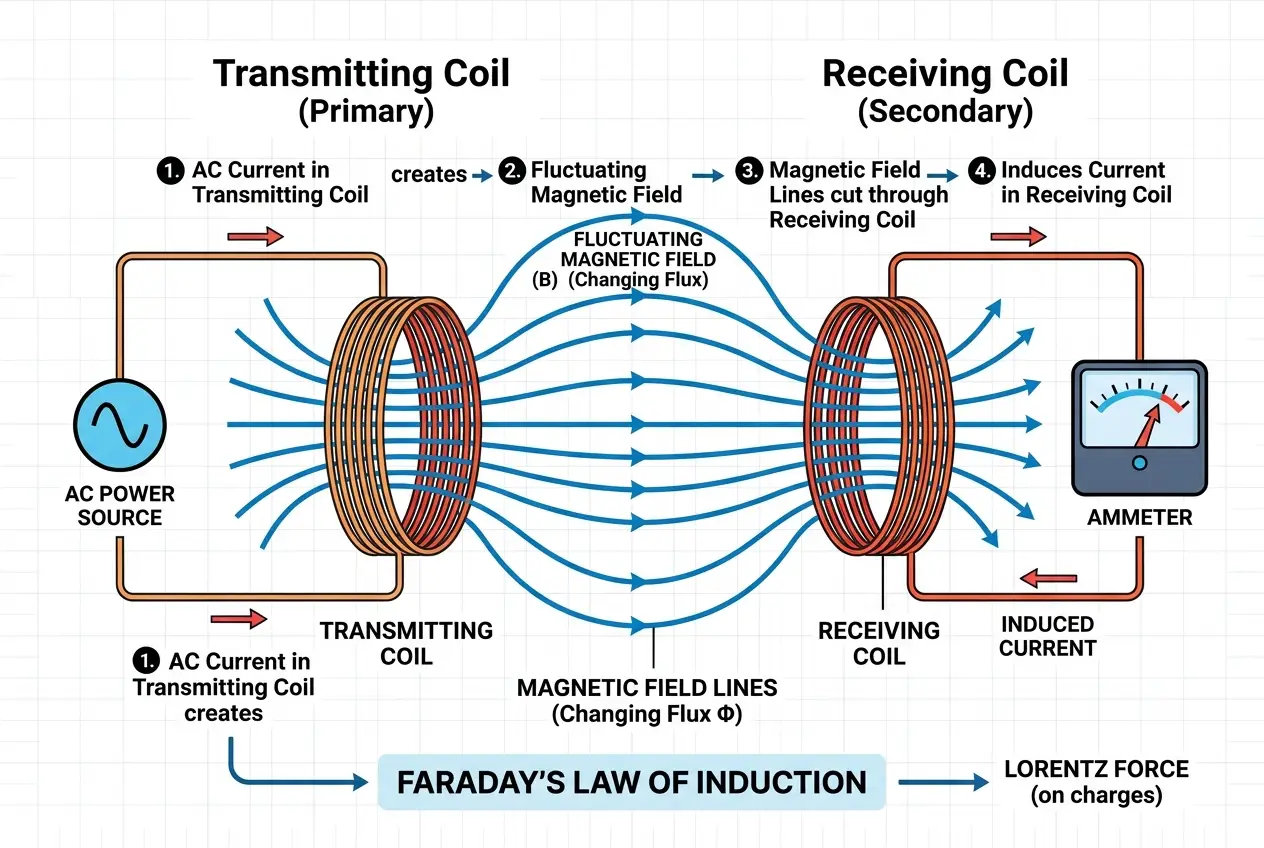
At the heart of wireless charging lies a phenomenon discovered by Michael Faraday in the 19th century: **electromagnetic induction**. Simply put, if you run an electric current through a wire, it creates a magnetic field around that wire. Conversely, if you expose a wire to a changing magnetic field, it will induce an electric current in that wire. This two-way street between electricity and magnetism is the cornerstone of how everything from electric generators to wireless charging pads operate.
Imagine two coils of wire. One coil, the **transmitter coil**, is embedded in your charging pad. When you plug the pad into a power source, an alternating current (AC) flows through this transmitter coil. This AC creates a fluctuating, or changing, magnetic field around the pad.
Now, your smartphone or other wirelessly chargeable device has a second coil, the **receiver coil**, built into it. When you place your device on the charging pad, its receiver coil enters this fluctuating magnetic field. According to Faraday's law, this changing magnetic field then induces an alternating current in the receiver coil of your phone.
This induced AC is then converted into direct current (DC) by rectification circuitry within your phone, which is then used to charge the device's battery. It’s a remarkably elegant system, turning an invisible magnetic field into tangible electrical power. You can learn more about the specifics of electromagnetic induction on [Wikipedia's page on Electromagnetic Induction](https://en.wikipedia.org/wiki/Electromagnetic_induction).
### The Resonance Advantage: Boosting Efficiency and Range
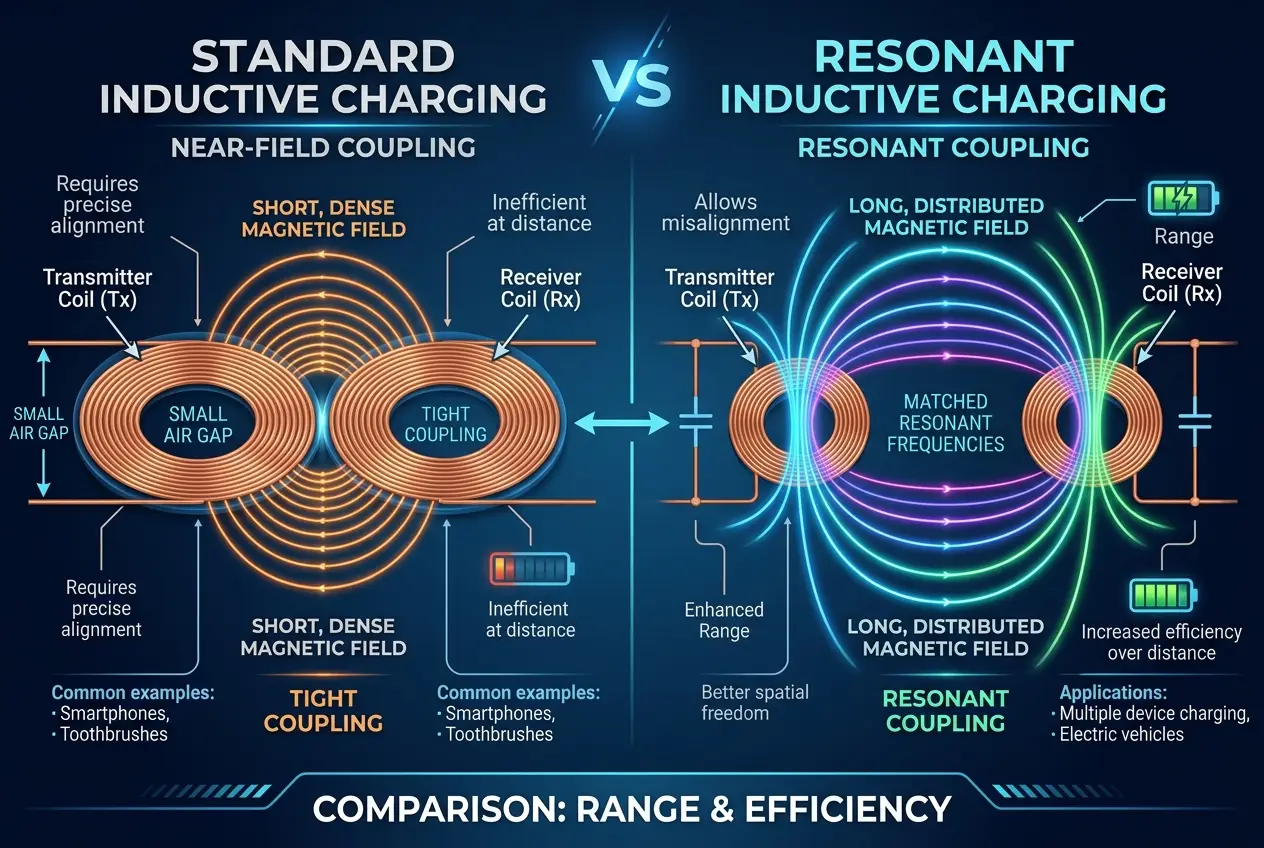
While basic electromagnetic induction works for close-range charging (like your electric toothbrush), it becomes less efficient over greater distances or when coils aren't perfectly aligned. This is where **resonant inductive coupling** comes into play, a more advanced form of wireless power transfer that most modern devices use.
Think of it like tuning two musical instruments to the same frequency. If you strike a tuning fork, another tuning fork nearby will vibrate and produce sound if they are both tuned to the same resonant frequency. In wireless charging, both the transmitter and receiver coils are designed to resonate at the same frequency.
When the transmitting coil is energized at its resonant frequency, it creates a more powerful and focused magnetic field. The receiving coil, being tuned to the exact same frequency, is then much more efficient at "absorbing" this energy, even if it's slightly further away or not perfectly centered. This resonance significantly increases the efficiency and effective range of the power transfer. Without resonance, much of the magnetic energy would simply dissipate into the environment. This distinction is crucial for understanding how our wireless earbuds get their power so clearly, as explored in a previous post, "[What Makes Your Wireless Earbuds Sound So Clear?](https://curiositydiaries.com/blogs/what-makes-your-wireless-earbuds-sound-so-clear-8550)".
### The Qi Standard: Unifying the Wireless World
For years, the dream of universal wireless charging was hampered by proprietary standards. Devices from different manufacturers often required specific charging pads. This changed dramatically with the advent of the **Qi (pronounced "chee") standard**, developed by the Wireless Power Consortium (WPC).
Qi has become the dominant global standard for inductive wireless charging, supported by hundreds of companies, including major smartphone manufacturers. When you see a "Qi-certified" logo on a charging pad or a device, it means they are designed to work together seamlessly. This widespread adoption has been a game-changer, fostering compatibility and accelerating the integration of wireless charging into countless products. You can dive deeper into the Qi standard's history and technical specifications on its [Wikipedia page](https://en.wikipedia.org/wiki/Qi_(standard)).
### Components of a Wireless Charging System
Let’s break down the typical wireless charging setup:
1. **Charging Pad (Transmitter):**
* **Power Source:** Connects to a wall outlet, providing electricity.
* **Transmitter Coil:** An induction coil that generates the alternating magnetic field.
* **Oscillator:** Converts the incoming DC power into high-frequency AC current for the coil.
* **Control Unit:** Manages the power transfer, detects the presence of a compatible device, and regulates output.
2. **Receiving Device (Receiver):**
* **Receiver Coil:** An induction coil within your phone or device that captures the magnetic field.
* **Rectifier:** Converts the induced AC current back into DC current.
* **Voltage Regulator:** Ensures a stable voltage is delivered to the battery, protecting it from overcharging.
* **Charging Circuit:** Connects to the device's battery to replenish its charge.
The communication between the pad and the device is crucial. The charging pad doesn't just blast power blindly. When a device is placed on the pad, a low-power "ping" is sent to detect its presence. If a compatible device responds, a handshake protocol is initiated, negotiating power levels and ensuring safe, efficient charging.
### Advantages and Disadvantages of Wireless Charging
While undeniably convenient, wireless charging comes with its own set of pros and cons:
**Advantages:**
* **Convenience:** No fumbling with cables, just place and charge.
* **Reduced Port Wear:** Eliminates physical wear and tear on charging ports.
* **Water Resistance:** Easier to design devices with better water resistance as there's no exposed port.
* **Aesthetics:** A cleaner, less cluttered charging area.
* **Safety:** Reduced risk of electric shock compared to exposed wired connections.
**Disadvantages:**
* **Slower Charging Speeds:** Generally slower than wired fast charging, though speeds are improving.
* **Heat Generation:** Inherent energy loss can generate more heat, potentially impacting battery longevity over time.
* **Efficiency Loss:** Energy is lost as heat during the transfer, making it less energy-efficient than wired charging.
* **Proximity Dependent:** Devices must be placed on or very close to the charging pad.
* **Cost:** Wireless charging pads and integrated components can add to the device's cost.
### Beyond Phones: The Future of Wireless Power
The potential of wireless power extends far beyond our handheld gadgets. Imagine a world where electric vehicles charge simply by parking over a pad, eliminating the need for bulky charging stations and cables. Companies are already developing **wireless EV charging** solutions that leverage resonant induction, promising a more seamless and automated future for electric transportation. This technology shares similarities with how EV batteries power our drives, a topic we've covered in detail in "[EV Batteries: How Do They Actually Power Your Drive?](https://curiositydiaries.com/blogs/ev-batteries-how-do-they-actually-power-your-drive-3920)".
Furthermore, wireless power could revolutionize medical implants, powering devices without invasive surgeries for battery replacement. Smart homes could see entire rooms bathed in a low-power electromagnetic field, passively charging all compatible devices as they move about, eliminating batteries entirely for many small electronics. The challenge lies in developing safe, efficient, and long-range power transfer solutions that can operate effectively across larger distances and through various materials.
### Safety and Security Considerations
As with any technology involving electromagnetic fields, safety is paramount. Wireless charging pads are designed to operate at frequencies that are generally considered safe for human exposure, adhering to international guidelines. The power output is relatively low and diminishes rapidly with distance.
However, like any electronic device, excessive heat generation can be a concern, especially if the phone is misaligned or foreign objects (like metal coins) interfere with the magnetic field. Most modern wireless chargers incorporate foreign object detection (FOD) systems to prevent power transfer in such scenarios, enhancing safety.
### Conclusion: The Invisible Power Grid
What once seemed like futuristic magic is now a common convenience, thanks to the elegant physics of electromagnetic induction and resonant coupling. Wireless charging represents more than just a convenience; it's a stepping stone towards a truly wire-free future where power is as ambient and accessible as Wi-Fi. As researchers continue to push the boundaries of efficiency, range, and multi-device charging, the invisible power grid supporting our digital lives will only become more integrated and indispensable. I find it truly fascinating how principles discovered centuries ago are still shaping the modern innovations that simplify our everyday experiences.
Frequently Asked Questions
Most consumer wireless charging (like Qi standard) works over very short distances, typically 3-7 millimeters (0.1 to 0.3 inches). This requires direct contact or very close proximity between the device and the charging pad for efficient power transfer. Researchers are working on longer-range solutions, but they are not yet widespread commercially.
Wireless charging can generate more heat than wired charging due to energy conversion losses. Excessive heat is a known factor that can degrade battery health over time. However, modern wireless charging systems have safeguards and intelligent power management to minimize heat and protect the battery. Using certified chargers and ensuring proper device alignment can also help.
No, only devices with a built-in wireless charging receiver coil are compatible with wireless charging. Most newer flagship smartphones from major brands include this feature. Older phones or budget models may require an external adapter or case to enable wireless charging.
Wired charging is generally more energy-efficient than wireless charging. During wireless power transfer, some energy is inevitably lost as heat due to the conversion between electricity and magnetic fields, and back again. While efficiency is continually improving, it typically ranges from 70-85% for wireless compared to 90-95% for wired charging.
Modern wireless chargers are designed to comply with electromagnetic compatibility (EMC) standards to minimize interference. However, as with any device emitting electromagnetic fields, there is a theoretical potential for interference with highly sensitive medical devices like pacemakers if placed in very close proximity. It is always best for individuals with such devices to consult their doctor or device manufacturer for guidance.
Verified Expert
Alex Rivers
A professional researcher since age twelve, I delve into mysteries and ignite curiosity by presenting an array of compelling possibilities. I will heighten your curiosity, but by the end, you will possess profound knowledge.
Leave a Reply
Comments (0)
No approved comments yet. Be the first to share your thoughts!
 Join Us



 Unknown Author



































Leave a Reply
Comments (0)