I remember the first time I heard about 5G, I was sitting in a bustling coffee shop, struggling with a sluggish internet connection on my phone. The barista mentioned, "Oh, once we get 5G here, things will fly!" At that moment, 5G sounded less like a technology and more like a mythical beast, promising unprecedented speed and connectivity. But have you ever stopped to truly wonder what 5G actually is, and how your phone, a relatively small device in your pocket, manages to tap into this invisible, ultra-fast network?
It's a question that often crosses my mind when I’m streaming a high-definition video without a single buffer, or downloading a massive file in seconds. We interact with 5G every day, sometimes without a second thought, yet the intricate dance of radio waves, cell towers, and sophisticated processing that makes it all possible remains largely hidden. Today, I want to pull back the curtain on this marvel of modern engineering, explaining the magic behind how your phone connects to the future.
### The Foundation: Understanding Wireless Communication
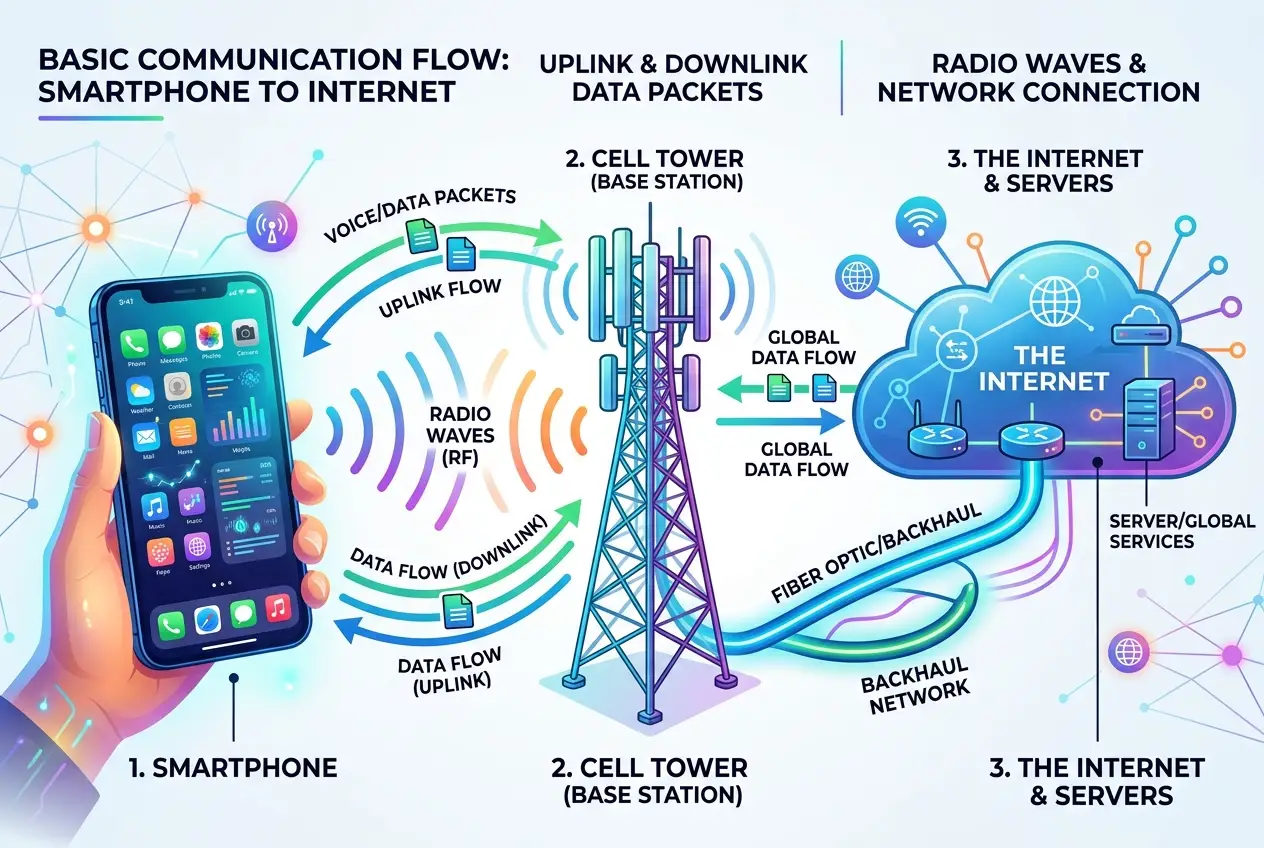
Before diving into the specifics of 5G, it’s essential to grasp the basic principles of how any wireless communication works. At its core, your phone communicates by sending and receiving **radio waves**. These are a form of electromagnetic radiation, just like light, but with much longer wavelengths. When you make a call, send a text, or browse the internet, your phone converts your data into electrical signals, which are then transformed into radio waves by an antenna.
These radio waves travel through the air until they reach a nearby cellular base station, commonly known as a cell tower. The cell tower then relays your data to the network, and vice-versa. This entire process happens in milliseconds, creating a seamless communication experience. Think of it like a conversation: your phone speaks in radio waves, the cell tower listens and speaks back, and the network translates.
### What Makes 5G Different? The Leap Beyond 4G
The transition from 4G (LTE) to 5G isn't just about speed; it's a fundamental architectural shift. While 4G brought us mobile broadband and enabled services like streaming video and social media on the go, 5G is designed to handle an exponential increase in data traffic, connect billions of devices, and support applications that require ultra-low latency.
The key differentiators of 5G can be broken down into three main pillars:
1. **Enhanced Mobile Broadband (eMBB):** This is what most of us notice first—blazing fast speeds. 5G can achieve theoretical peak speeds of up to 10 gigabits per second (Gbps), significantly faster than 4G's typical speeds. This means faster downloads, smoother streaming, and a more responsive internet experience.
2. **Ultra-Reliable Low-Latency Communications (URLLC):** Latency is the delay between sending a signal and receiving a response. 5G aims for incredibly low latency, potentially as low as 1 millisecond. This is crucial for applications like autonomous vehicles, remote surgery, and industrial automation where real-time responses are critical.
3. **Massive Machine-Type Communications (mMTC):** This pillar focuses on connecting a vast number of devices simultaneously, from smart sensors in a city to countless IoT (Internet of Things) gadgets. 5G is built to support up to a million devices per square kilometer, far exceeding 4G's capacity.
These advancements are powered by several groundbreaking technologies that differentiate 5G from its predecessors.
### The Core Technologies Powering 5G
To achieve these ambitious goals, 5G networks utilize a combination of new and evolved technologies.
#### **1. Millimeter Wave (mmWave) and Sub-6 GHz Frequencies**
One of the most significant changes in 5G is the use of a wider range of radio frequencies.
* **Sub-6 GHz:** These are similar to the frequencies used by 4G, lying below 6 GHz. They offer a good balance of coverage area and penetration through obstacles. This is often referred to as "mid-band" 5G and forms the backbone of widespread 5G coverage, providing decent speeds and reach.
* **mmWave:** This is where the truly mind-boggling speeds come from. Millimeter wave frequencies are much higher, typically ranging from 24 GHz to 100 GHz. These higher frequencies allow for massive bandwidth, meaning they can carry a lot more data at once. The trade-off? mmWave signals have a very short range and struggle to penetrate solid objects like walls or even heavy rain. This is why mmWave 5G often requires a denser network of smaller cell sites, making it ideal for urban areas, stadiums, and specific high-demand zones. You can learn more about how wireless communication operates on different frequencies on its [Wikipedia page on Radio Waves](https://en.wikipedia.org/wiki/Radio_wave).
#### **2. Massive MIMO (Multiple-Input, Multiple-Output)**
MIMO technology isn't new; 4G networks also use it. However, 5G takes it to an entirely new level, hence "Massive MIMO." Instead of just a few antennas, 5G base stations can incorporate dozens or even hundreds of tiny antennas.
Imagine a room where many people are trying to talk at once. It's noisy and hard to understand. Now imagine each person having a dedicated microphone and speaker, and everyone can intelligently direct their voice to the right listener. That's essentially what Massive MIMO does. By using many antennas, a 5G cell tower can:
* **Send and receive more data simultaneously:** This significantly increases network capacity.
* **Create multiple independent data streams:** It can serve many users at once, even if they are using the same frequency.
#### **3. Beamforming**
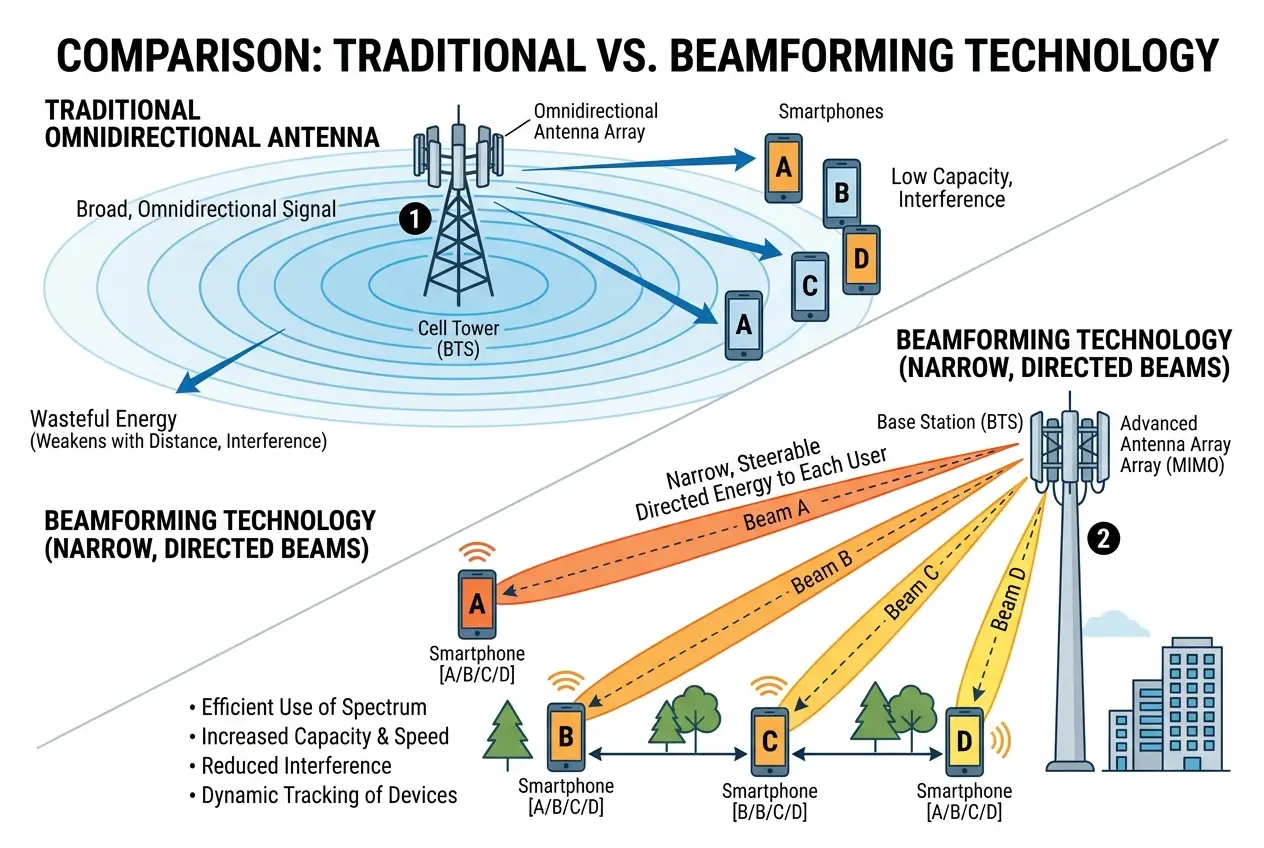
Closely related to Massive MIMO is **beamforming**. Instead of broadcasting signals in all directions (like a traditional radio antenna), beamforming directs a focused beam of radio waves directly towards your phone. This is like shining a spotlight instead of flooding the entire room with light.
Benefits of beamforming:
* **Improved signal strength:** More power is concentrated on your device, leading to faster and more reliable connections.
* **Reduced interference:** By focusing the signal, it minimizes interference with other devices or signals.
* **Extended range:** Even with higher frequencies, beamforming can help overcome some of the range limitations.
#### **4. Small Cells**
Given the limitations of mmWave, 5G networks often rely heavily on **small cells**. These are miniature base stations, much smaller than traditional cell towers, that can be mounted on streetlights, utility poles, or buildings. They cover much smaller areas, but because they are closer to users and can be deployed densely, they significantly boost capacity and speed in specific locations. This deployment strategy is critical for providing robust 5G coverage, especially in dense urban environments.
#### **5. Network Slicing**
This is a concept that truly highlights 5G's flexibility. Network slicing allows mobile operators to create multiple virtual networks on top of a single physical 5G infrastructure. Each "slice" can be customized with specific performance characteristics like speed, latency, and reliability to suit different applications.
For example:
* One slice could be optimized for high-speed mobile broadband for consumers.
* Another slice could be configured for ultra-low latency for an autonomous vehicle fleet.
* A third slice could be designed for massive IoT connectivity, prioritizing low power consumption over speed.
This means resources are allocated much more efficiently, ensuring that critical applications get the performance they need without impacting other services.
### How Your Phone Connects to 5G
So, with all these complex technologies, what exactly happens when your phone lights up with that "5G" icon?
1. **The 5G Modem:** Your smartphone needs a specialized 5G modem and antenna system. This hardware is designed to communicate across the various 5G frequency bands (sub-6 GHz and mmWave) and to decode the complex signals enabled by Massive MIMO and beamforming.
2. **Searching for a Signal:** When you're in an area with 5G coverage, your phone's modem constantly scans for available 5G signals. It tries to detect signals from nearby 5G base stations or small cells.
3. **Handshake and Authentication:** Once a 5G signal is detected, your phone initiates a "handshake" process with the network. This involves exchanging information to authenticate your device and subscriber identity (via your SIM card). The network verifies that you have a valid 5G subscription.
4. **Resource Allocation:** The network then allocates resources to your phone, potentially assigning you to a specific network slice based on your service plan or current needs. It might even use beamforming to direct a focused signal specifically to your device.
5. **Data Transmission:** With the connection established, your phone can now send and receive data at 5G speeds. If you move out of a 5G area, your phone will seamlessly "fall back" to a 4G LTE connection, maintaining your connectivity. The continuous evolution of cellular networks is quite fascinating, and you can explore more about the history and future of connectivity, perhaps even about the speculative future of communication technology in our article about if 6G is the key to teleportation. For the technical details behind wireless signal transmission, Wikipedia offers a comprehensive overview of [5G technology](https://en.wikipedia.org/wiki/5G).
### The Future Beyond 5G
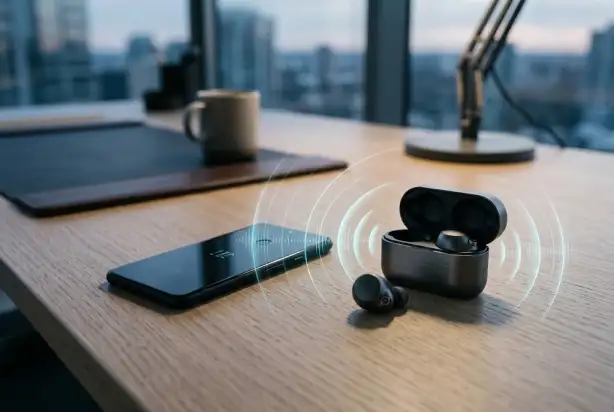
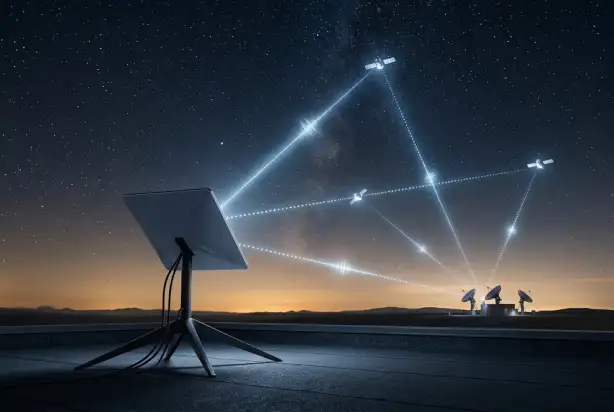
5G is still relatively new and its full potential is yet to be realized. As networks mature and more devices become 5G-enabled, we'll see even more transformative applications emerge. From enhanced augmented and virtual reality experiences to smart cities that leverage vast sensor networks, 5G is laying the groundwork for a truly interconnected world. The journey of wireless technology is ceaseless; for example, understanding the intricacies of how your devices, such as wireless earbuds, achieve their clarity might provide further insight into the broader principles of wireless communication. Meanwhile, another fundamental aspect of modern tech that relies on signals is how satellites know your exact location, a testament to global positioning technologies.
The invisible technology working behind the scenes to power our mobile experience is a testament to human ingenuity. The next time your phone downloads an app in a flash or streams a video without a hiccup, take a moment to appreciate the complex symphony of radio waves, antennas, and algorithms that make the magic of 5G happen. We're living in an era where the lines between science fiction and reality are constantly blurring, and 5G is a prime example of this exhilarating progression.
Frequently Asked Questions
The main difference is 5G offers significantly faster speeds, much lower latency (less delay), and the ability to connect a far greater number of devices simultaneously compared to 4G, enabling new applications like smart cities and autonomous vehicles.
To use 5G, you need a smartphone equipped with a 5G modem and compatible antennas. Older 4G-only phones cannot access 5G networks. If your phone was released in the last few years and is advertised as 5G-capable, then it likely supports it.
5G performance and coverage vary. High-speed 'mmWave' 5G has short range and difficulty penetrating objects, leading to localized fast zones. Sub-6 GHz 5G offers broader coverage but might not always deliver peak speeds due to network congestion or distance from a tower. Network build-out is also ongoing, so coverage is continuously expanding.
Latency refers to the delay between when your device sends a signal and when it receives a response from the network. 5G's ultra-low latency (down to 1 millisecond) is crucial for applications that require immediate feedback, such as remote surgery, autonomous driving, and real-time gaming, where even tiny delays can have significant consequences.
While 5G offers powerful wireless connectivity, it’s unlikely to completely replace Wi-Fi. Both technologies serve different purposes and often complement each other. Wi-Fi is still more suitable for high-bandwidth, local area networking within homes and offices, while 5G excels at wide-area mobile connectivity and supporting a vast number of IoT devices.
Verified Expert
Alex Rivers
A professional researcher since age twelve, I delve into mysteries and ignite curiosity by presenting an array of compelling possibilities. I will heighten your curiosity, but by the end, you will possess profound knowledge.
Leave a Reply
Comments (0)
No approved comments yet. Be the first to share your thoughts!
 Join Us



 Unknown Author































Leave a Reply
Comments (0)