I often find myself commuting through the bustling city, surrounded by the constant drone of traffic, chattering voices, and the incessant rumble of the subway. For years, this was just an accepted part of my daily routine, a symphony of urban chaos. Then, one day, I experienced something truly transformative: active noise-canceling headphones. It wasn't just a reduction in noise; it felt like the world around me had suddenly pressed a mute button, replaced by an eerie, delightful silence. I could hear my music, my podcast, or even just my own thoughts, with a clarity I hadn't realized I was missing.
This wasn't magic, of course. It was a remarkable feat of modern engineering and a clever application of physics. But how exactly do these devices, often no larger than your palm, manage to perform such a seemingly impossible trick? How do they "know" what sounds to cancel and how to create that tranquil bubble around your ears? Let's dive into the fascinating science behind active noise cancellation (ANC) and uncover the technology that gives us our precious moments of quiet.
## The Invisible Battle: Understanding Sound Waves
To grasp how noise cancellation works, we first need to understand the fundamental nature of sound. Sound, at its core, is a vibration that travels through a medium – air, water, or even solid objects – as a wave. Imagine dropping a pebble into a still pond; ripples spread out from the center. Sound waves behave similarly, consisting of areas of compression (higher pressure) and rarefaction (lower pressure) that propagate outwards.
Every sound, from a whisper to a jet engine, has specific characteristics:
* **Amplitude:** This determines how loud the sound is. Larger amplitude means louder sound.
* **Frequency:** This determines the pitch of the sound. Higher frequency means a higher pitch.
* **Wavelength:** The physical distance between two consecutive peaks or troughs of a wave.
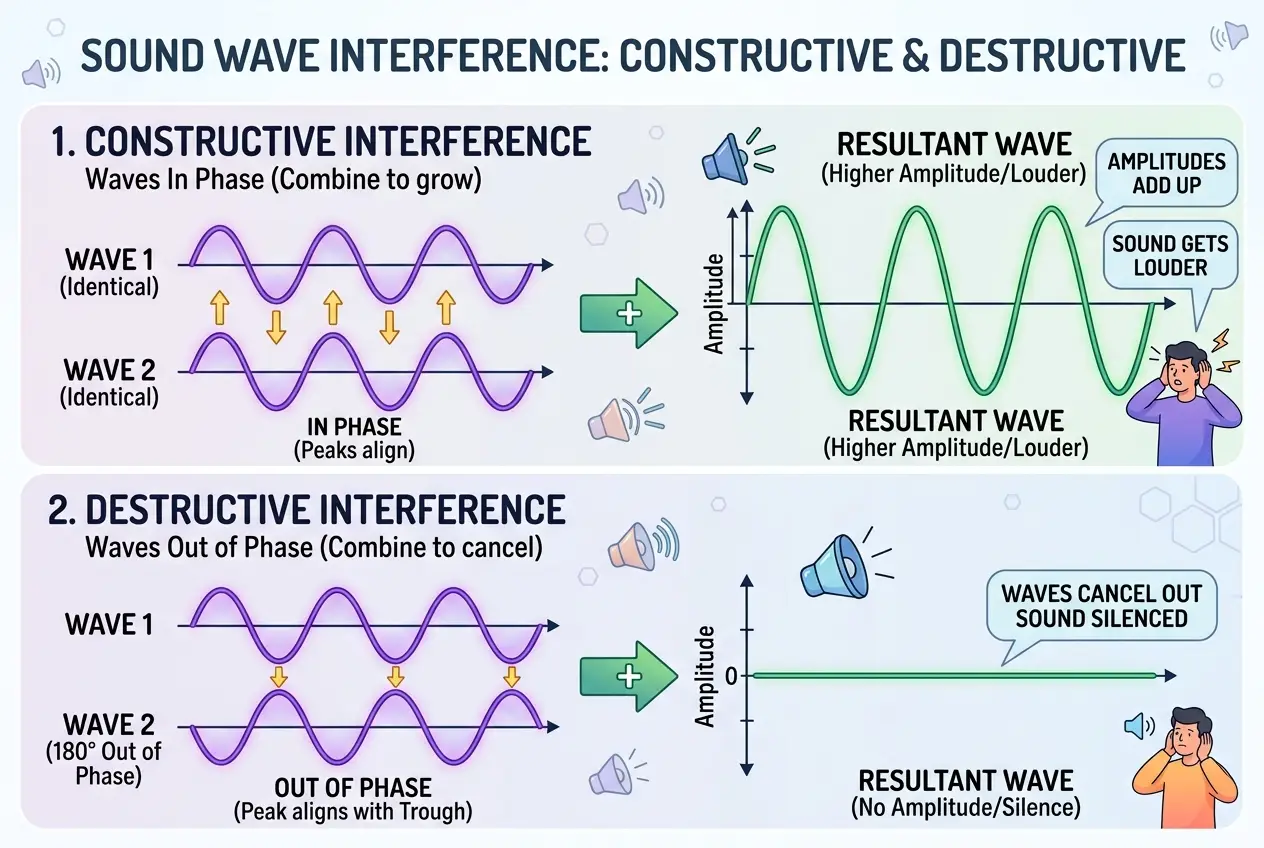
The key insight for noise cancellation lies in the wave nature of sound. Waves have a peculiar property: they can interact with each other. When two waves meet, they combine. This combination can either make the resulting wave bigger (constructive interference) or, crucially, make it smaller or even cancel it out entirely (destructive interference).
## The Ingenious Principle of Active Noise Cancellation
Active Noise Cancellation operates on the principle of **destructive interference**. The basic idea is simple yet brilliant: if you can generate a "second sound" that is precisely the inverse of the unwanted ambient noise, the two sounds will cancel each other out, resulting in silence.
Think of it like this: if an incoming sound wave has a peak (high pressure), the headphones generate a trough (low pressure) at that exact moment and location. If the incoming wave has a trough, the headphones generate a peak. These two perfectly opposing waves essentially "annihilate" each other.
This isn't as easy as it sounds, though. The cancellation needs to be incredibly precise, happening in real-time, and adapting to a constantly changing soundscape.
### How ANC Works: A Step-by-Step Breakdown
The magic of ANC headphones isn't concentrated in one component but a harmonious interplay of several advanced technologies.
#### 1. The Microphones: Eavesdropping on the World
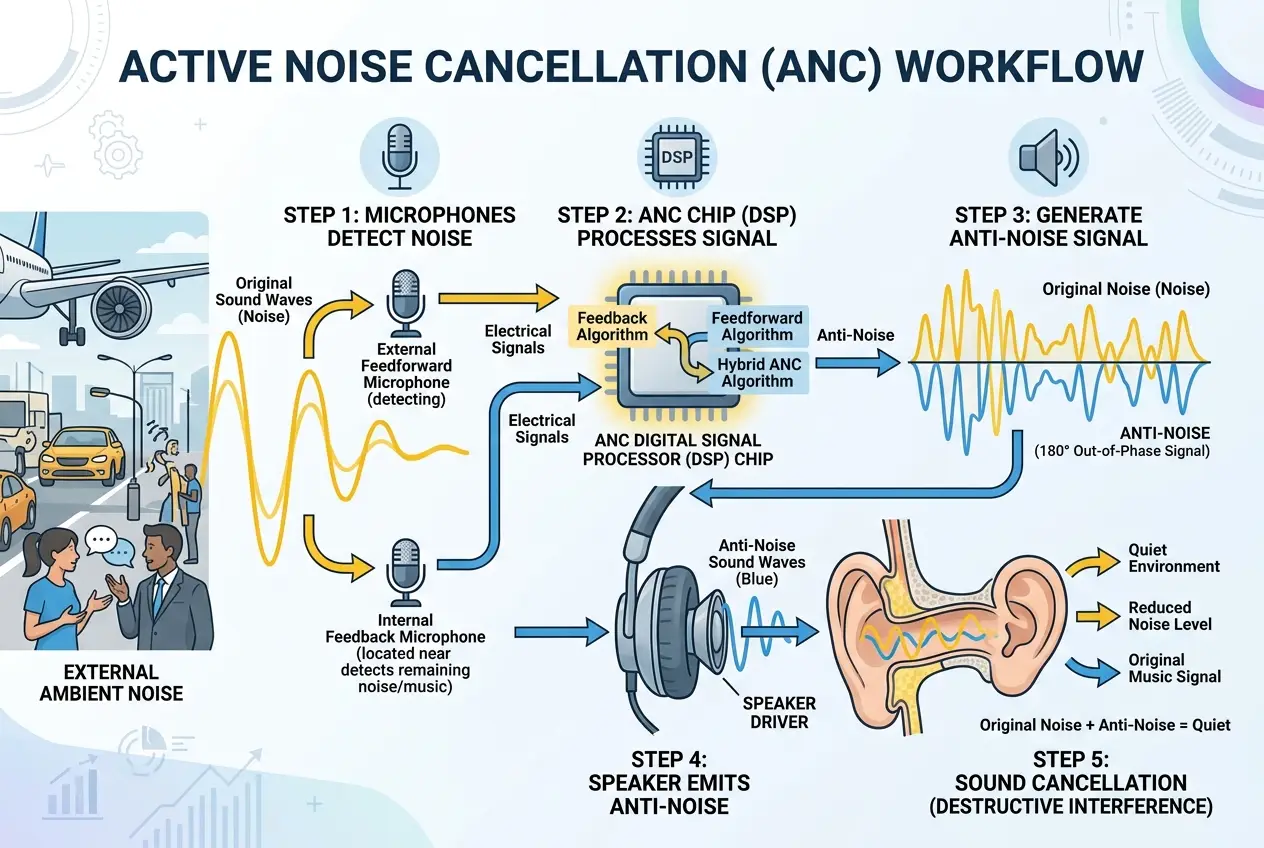
The first crucial step involves tiny microphones strategically placed on the headphones. Most ANC headphones use a combination of microphones:
* **Feedforward microphones:** Located on the *outside* of the earcups, these listen to the ambient noise before it even reaches your ears. They pick up the sounds of the environment, such as engine hums, fan noise, or general chatter.
* **Feedback microphones:** Positioned *inside* the earcups, closer to your ear, these listen to the sound that actually makes it past the earcups and any passive noise reduction. This allows the system to monitor exactly what you're hearing and fine-tune the cancellation.
* **Hybrid systems:** Many high-end headphones use both feedforward and feedback microphones for optimal performance, combining the proactive noise sensing with reactive correction.
You can learn more about how microphones work by checking out our blog on [Can Sound Waves Manipulate Matter at Quantum Level?](/blogs/can-sound-waves-manipulate-matter-at-quantum-level-7533) for a deeper dive into sound at a fundamental level.
#### 2. The ANC Chip: The Brain of the Operation
Once the microphones capture the incoming noise, the analog sound waves are converted into digital signals. These digital signals are then fed into a highly specialized **ANC chip**, also known as a Digital Signal Processor (DSP). This chip is the brain of the entire operation.
The DSP performs several critical functions in milliseconds:
* **Analyzes the incoming noise:** It rapidly analyzes the frequency, amplitude, and phase of the unwanted sound.
* **Generates the anti-noise:** Based on the analysis, the DSP generates an "anti-noise" sound wave that is precisely 180 degrees out of phase with the detected noise. This means its peaks align with the noise's troughs, and its troughs align with the noise's peaks.
* **Adapts in real-time:** The environment is dynamic. The DSP continuously monitors the noise and adjusts the anti-noise signal to maintain effective cancellation. This is where advanced algorithms and machine learning (though often simpler forms for real-time processing) come into play, allowing the headphones to adapt to changing sounds.
#### 3. The Speakers: Projecting Silence
The generated anti-noise signal, still in digital form, is then converted back into an analog electrical signal and sent to the headphone speakers. These speakers, in addition to playing your music, are tasked with emitting the anti-noise directly into your ear canal.
When the anti-noise wave meets the original unwanted noise wave inside your ear, they destructively interfere, effectively canceling each other out. The result is a significant reduction in perceived ambient noise, creating that cherished quiet space.
## The Science of Silence: Beyond Just Flipping the Phase
While the 180-degree phase shift is the core concept, the actual implementation involves sophisticated signal processing. The effectiveness of ANC heavily depends on several factors:
### Frequency Ranges
ANC is most effective at canceling **low-frequency, continuous sounds**. Think of airplane engine hums, bus rumbling, or the whir of an air conditioner. These sounds have predictable, repetitive waveforms, making it easier for the DSP to generate an accurate anti-noise signal. This is why you feel that profound quiet on a plane with ANC headphones.
Higher-frequency sounds, like human voices, sudden sharp noises, or a baby crying, are much harder to cancel actively. Their waveforms are more complex, less predictable, and change rapidly. While ANC can reduce their intensity, it typically won't eliminate them entirely. For these sounds, the passive noise isolation provided by the physical design of the earcups and ear cushions plays a more significant role.
### Latency and Accuracy
The entire process, from noise detection to anti-noise emission, must happen in milliseconds. Any significant delay (latency) would mean the anti-noise arrives too late, potentially reinforcing the noise rather than canceling it. The accuracy of the anti-noise signal is also paramount; even slight discrepancies in phase or amplitude can reduce cancellation effectiveness. This requires powerful, efficient processing hardware and sophisticated algorithms.
### Adaptive vs. Non-Adaptive ANC
* **Non-adaptive ANC:** Uses a fixed anti-noise signal, primarily effective against very specific, constant noises. Less common in consumer headphones today.
* **Adaptive ANC:** The gold standard. These systems continuously monitor the ambient noise and adjust the anti-noise in real-time. Some advanced adaptive ANC systems can even learn your environment over time, optimizing cancellation for your typical surroundings.
For insights into other fascinating sound phenomena, consider exploring our article on [Can Sound Create Light? Unpacking Sonoluminescence](/blogs/can-sound-create-light-unpacking-sonoluminescence-3271).
## The Trade-offs and Future of ANC
While incredibly effective, ANC technology isn't without its considerations.
**Battery Life:** The continuous processing and anti-noise generation require significant power, which is why ANC headphones generally have shorter battery lives than their passive counterparts.
**Sound Quality:** Early ANC systems sometimes introduced a subtle "hiss" or affected the audio quality of music. Modern systems have largely overcome this, but it remains a design challenge to ensure pristine sound quality alongside effective noise cancellation.
**Pressure Sensation:** Some users report a slight "pressure" feeling in their ears, akin to being in a pressurized cabin, especially with very strong ANC. This is often due to the brain perceiving the absence of expected low-frequency noise.
### The Evolution of Quiet
The future of ANC is exciting. We're seeing advancements in:
* **Personalized ANC:** Systems that can map the unique acoustics of a user's ear canal and adjust cancellation accordingly.
* **Contextual ANC:** Headphones that automatically adjust cancellation levels based on your environment (e.g., strong ANC on a plane, lighter ANC in an office, or even a transparency mode when you need to hear announcements).
* **Integration with AI:** More sophisticated AI algorithms could predict noise patterns, leading to even more seamless and effective cancellation.
* **Smaller, More Efficient Hardware:** As chips become smaller and more powerful, ANC technology will likely become ubiquitous, appearing in more compact form factors like true wireless earbuds with even better performance.
This technology isn't just for music lovers; it's a tool for focus, relaxation, and even well-being in an increasingly noisy world. Imagine future cities where noise pollution is a thing of the past, thanks to advanced sound manipulation. You might be surprised by the possibilities, similar to how we explored [Acoustic Levitation: Can Sound Build Future Cities?](/blogs/acoustic-levitation-can-sound-build-future-cities-4674)
In conclusion, the seemingly simple act of putting on noise-canceling headphones and experiencing silence is a testament to sophisticated engineering, real-time signal processing, and a deep understanding of wave physics. It's a daily miracle that transforms our noisy realities into pockets of peaceful productivity.
## External Resources
* For a comprehensive overview of active noise control, you can check out its Wikipedia page: [Active noise control on Wikipedia](https://en.wikipedia.org/wiki/Active_noise_control)
* To understand more about the fundamental principles of sound, see: [Sound on Wikipedia](https://en.wikipedia.org/wiki/Sound)
* For detailed information on Digital Signal Processors, visit: [Digital signal processor on Wikipedia](https://en.wikipedia.org/wiki/Digital_signal_processor)
Frequently Asked Questions
No, active noise-canceling headphones are generally not bad for your ears. In fact, by reducing ambient noise, they can help you listen to music at lower volumes, potentially reducing the risk of hearing damage from prolonged exposure to loud sounds. The slight pressure sensation some users experience is typically harmless and not indicative of damage.
Yes, active noise-canceling headphones work to reduce ambient noise even when you're not playing music. The ANC system operates independently, generating anti-noise to cancel out environmental sounds. Many people use them simply to create a quiet environment for focus or relaxation.
Noise-canceling headphones are most effective at canceling low-frequency, continuous sounds because their waveforms are more predictable. High-pitched sounds have much shorter wavelengths and more complex, rapidly changing waveforms, making it challenging for the ANC chip to accurately generate and emit a perfectly phase-inverted anti-noise signal in real-time.
Yes, there's a significant difference. Passive noise cancellation (or noise isolation) relies on the physical design of the headphones, such as thick earcups and a snug fit, to block out sound. Active Noise Cancellation (ANC), as explained in the blog, uses electronics to actively generate anti-noise waves that cancel out incoming sound waves through destructive interference.
No, noise-canceling headphones cannot block out all sound. They are particularly effective at reducing low-frequency, consistent noises (like engine hums). However, sudden, sharp, or high-frequency sounds (like human speech or car horns) are much more difficult to cancel completely. The goal is significant noise reduction, not absolute silence.
Verified Expert
Alex Rivers
A professional researcher since age twelve, I delve into mysteries and ignite curiosity by presenting an array of compelling possibilities. I will heighten your curiosity, but by the end, you will possess profound knowledge.
Leave a Reply
Comments (0)
No approved comments yet. Be the first to share your thoughts!
 Join Us



 Unknown Author

































Leave a Reply
Comments (0)