I remember the first time I saw a movie character interact with digital elements floating in their field of view. It felt like pure science fiction, a distant dream of a future where information wasn't confined to screens but blended seamlessly with our physical world. Now, that future is rapidly becoming our present, thanks to **Augmented Reality (AR) glasses**. But have you ever stopped to wonder how these futuristic spectacles actually work? How do they manage to project crisp digital images right before your eyes, making them appear as if they're truly part of the environment, without blocking your view of reality?
It’s a feat of engineering that sounds like magic, but it’s rooted in some incredibly clever optical and computational technology. Unlike virtual reality (VR) headsets that completely immerse you in a digital world, AR glasses aim to **enhance your existing reality**. They don't just overlay pixels; they create an illusion where digital objects coexist with the real world, allowing you to check messages, get directions, or even play games while still seeing everything around you. This capability is what excites me most about AR, as it promises to transform how we interact with technology daily, making it less intrusive and more integrated.
### The Core Challenge: See-Through Digital Displays
The fundamental challenge in building AR glasses is creating a display that is both transparent and capable of projecting high-quality images. It's not as simple as sticking a tiny screen in front of your eyes. The light from that screen needs to be directed precisely into your pupil, while simultaneously allowing light from the real world to pass through unobstructed. This is where specialized optical components come into play.
There are several ingenious approaches to solve this, but most modern AR glasses rely on a combination of miniature projectors and advanced waveguides or reflective optics.
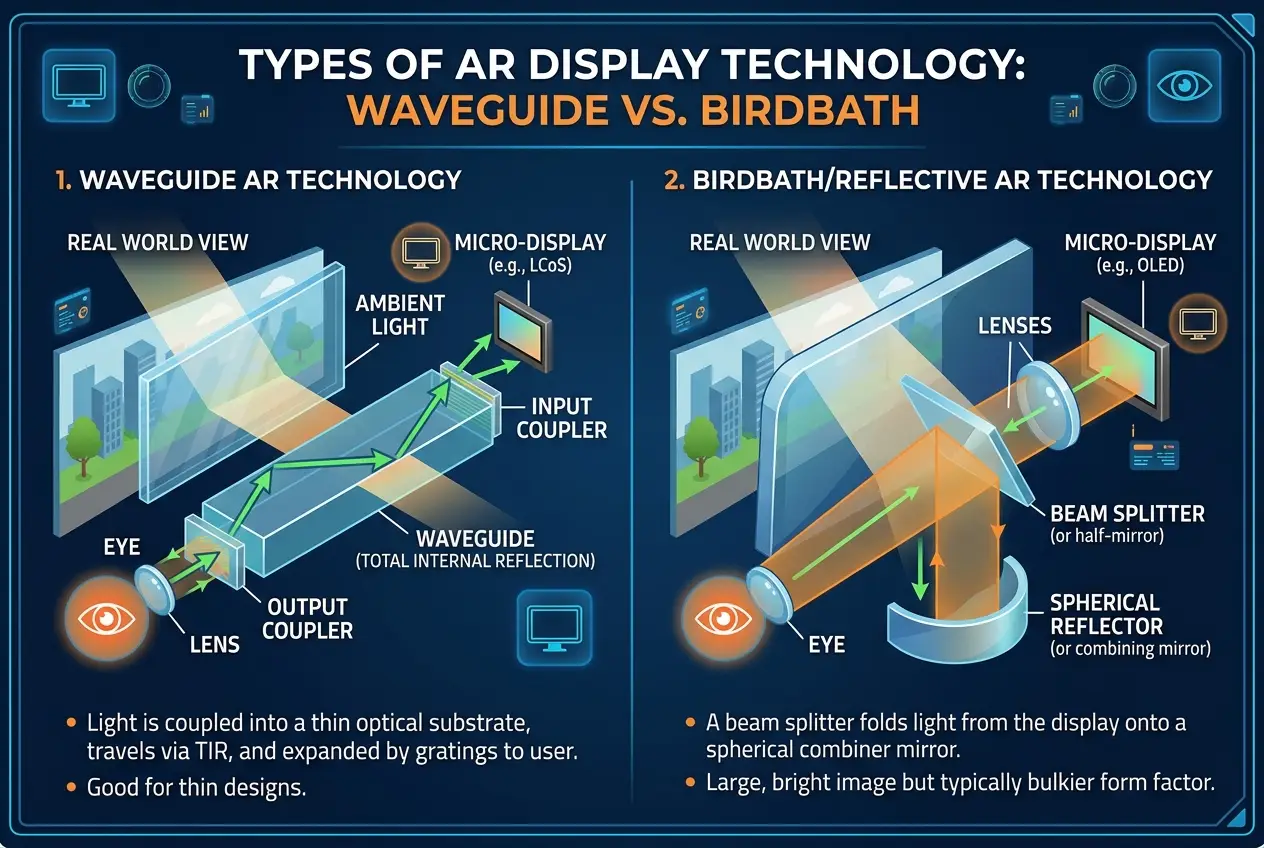
#### 1. The Waveguide Wonders
The most elegant solution, and one that promises sleek, everyday wearable AR glasses, is the **waveguide display**. Think of a waveguide like a tiny, transparent tunnel for light. Here's how it generally works:
* **Micro-Display:** A minuscule, high-resolution display (often micro-LED or micro-OLED) generates the digital image. These displays are incredibly small, sometimes just a few millimeters across, but pack millions of pixels.
* **Coupling Element:** Light from the micro-display is "coupled" or injected into the edge of the transparent lens (the waveguide) using a special optical component.
* **Total Internal Reflection:** Once inside the waveguide, the light travels along the glass or plastic lens, bouncing off the internal surfaces through a phenomenon called **Total Internal Reflection**. It's the same principle that keeps light inside fiber optic cables.
* **Out-Coupling Element:** As the light reaches the specific point in front of your eye, another optical structure (the out-coupling element) *extracts* the light, directing it straight into your pupil.
This entire process happens without obstructing the light from the real world passing through the main body of the lens. The result? Digital images appear to float in your environment, perfectly superimposed. This is why when you wear some high-end AR glasses, you can still see the world clearly, but also see a virtual interface. For a deeper dive into how light behaves in these scenarios, you might find this Wikipedia article on [Total Internal Reflection](https://en.wikipedia.org/wiki/Total_internal_reflection) insightful.
#### 2. Reflective Optics and Birdbath Designs
Another common technique, especially in larger or earlier AR systems, involves reflective optics, sometimes called "birdbath" optics due to their shape.
* **Micro-Display:** Again, a small display generates the image.
* **Partial Mirror/Combiner:** The light from this display is bounced off a partially reflective mirror or a series of mirrors. This mirror is strategically placed within the lens structure.
* **Direct Reflection to Eye:** This reflected light is then directed into your eye. Because the mirror is only *partially* reflective, a significant portion of the real-world light can still pass through it, allowing you to see your surroundings.
While often simpler to manufacture and capable of producing brighter, wider fields of view, birdbath designs tend to be bulkier and can sometimes create a slightly dimmer view of the real world because of the partial reflection. This is why some AR headsets look more like goggles than regular glasses.
### Beyond the Optics: The Brains Behind the Blend
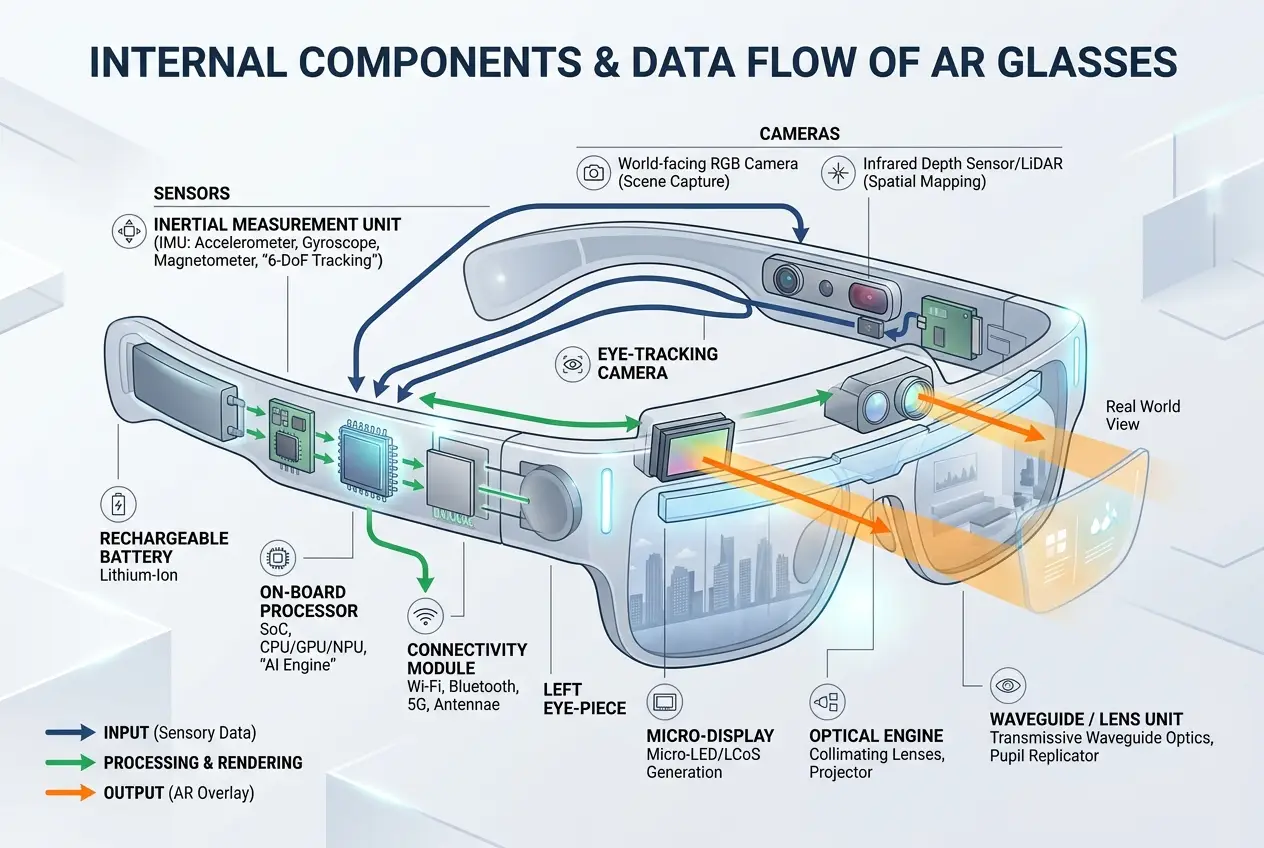
The optical system is only one part of the equation. For digital content to feel truly "real" in your environment, AR glasses need sophisticated computing power:
* **Sensors and Cameras:** Multiple cameras and sensors constantly scan the environment. They map your surroundings, track your head movements, and detect surfaces, objects, and even gestures. This is crucial for **spatial computing** – understanding where digital objects should be placed relative to the real world.
* **Simultaneous Localization and Mapping (SLAM):** This complex algorithm uses sensor data to build a real-time 3D map of your surroundings while simultaneously pinpointing the glasses' exact position within that map. Without SLAM, digital objects would appear to drift or be inaccurately placed, breaking the illusion. If you're curious about the intricate algorithms that power such systems, Wikipedia offers a great overview of [SLAM](https://en.wikipedia.org/wiki/Simultaneous_localization_and_mapping).
* **Processors and AI:** Dedicated processors, often including specialized AI chips, handle the vast amounts of sensor data and render complex 3D graphics in real-time. This is why your AR apps run smoothly, and why digital objects look stable and realistic as you move. A powerful processor is essential; without it, you'd experience lag, which immediately shatters the immersive experience. This constant processing is also what makes AR a significant leap from simple heads-up displays, requiring far more computational power than what we discussed in our blog on [how your phone gets 5G](blogs/how-does-your-phone-get-5g-the-invisible-tech-explained-3020) or even [how gaming GPUs forge reality](blogs/how-do-gaming-gpus-forge-reality-the-pixels-explained-7771).
* **Eye Tracking:** Many advanced AR glasses also incorporate eye-tracking technology. This allows the system to know exactly where you're looking, enabling more natural interactions and optimizing graphics. For instance, **foveated rendering** can render the area you're directly looking at in higher detail, saving processing power on peripheral vision.
### The "Why": Practical Applications and Real-World Value
So, why go through all this trouble? The real value of AR glasses lies in their practical applications:
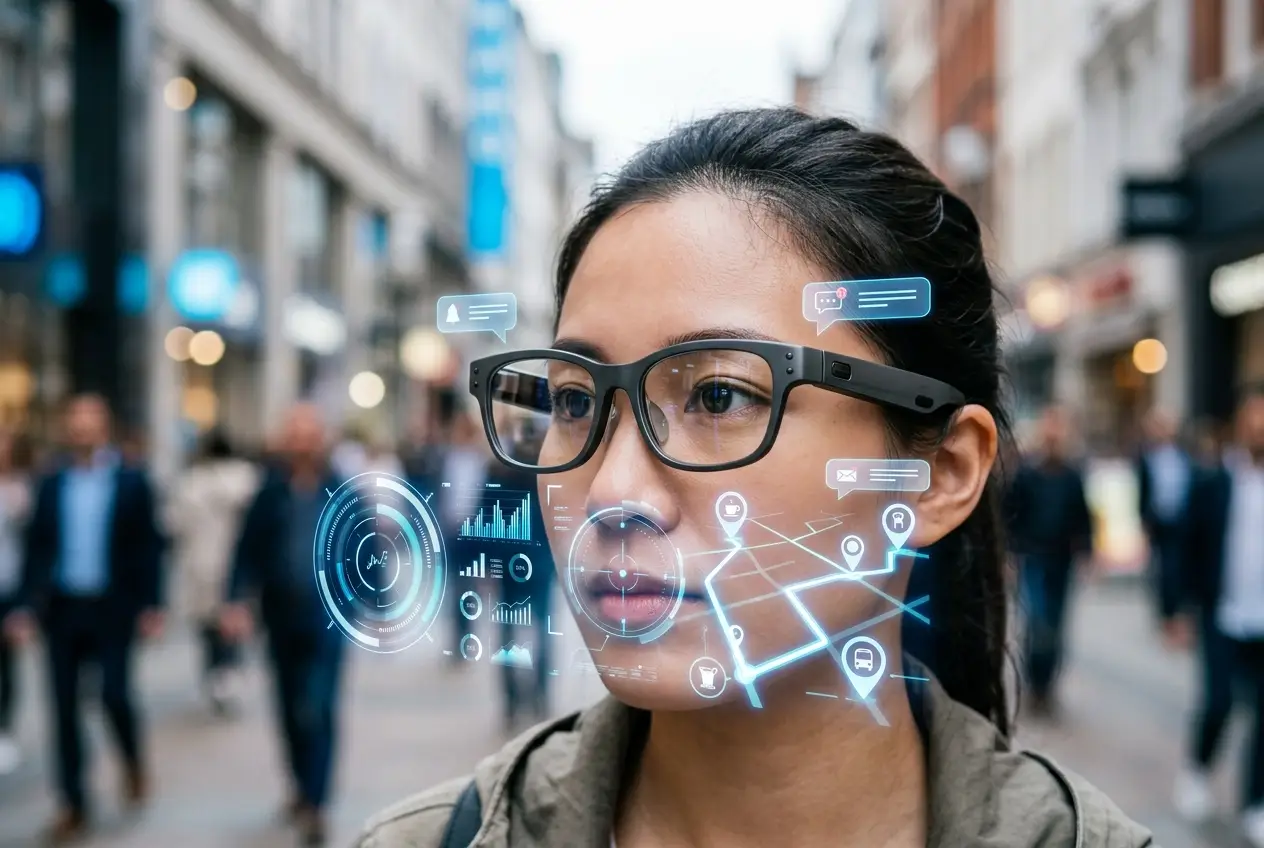
* **Enhanced Navigation:** Imagine walking through a city, and directions appear as arrows on the street in front of you, or points of interest are highlighted as you look at them. This is far more intuitive than constantly checking your phone.
* **On-the-Job Assistance:** Technicians could see digital overlays of instructions or diagnostic information directly on complex machinery, without having to consult a manual. Surgeons could view patient data during an operation without looking away.
* **Seamless Communication:** Notifications, calls, and messages could appear subtly in your peripheral vision, allowing you to stay connected without constantly pulling out a device.
* **Interactive Entertainment:** Gaming becomes blended with the real world, turning your living room into a battlefield or your park into an alien landscape.
* **Accessibility:** AR can provide real-time captions for conversations for the hearing impaired or visual aids for those with low vision, directly integrated into their line of sight.
This blend of digital information with physical presence is what makes AR so compelling. It's not just about flashy graphics; it's about making technology disappear into the background, becoming an intuitive extension of our natural perception. As the technology matures, I believe AR glasses will become as ubiquitous and indispensable as smartphones are today, fundamentally changing how we perceive and interact with information. The future of computing might not be on a screen in your hand, but seamlessly woven into the fabric of your reality. You can read more about the broader concept of [Augmented Reality](https://en.wikipedia.org/wiki/Augmented_reality) on Wikipedia for a comprehensive overview of its history and future.
### The Road Ahead
While current AR glasses are impressive, the technology is still evolving. Challenges remain in miniaturization, battery life, field of view, and making them truly indistinguishable from regular eyewear. However, the foundational technologies are proving incredibly robust, and innovations in micro-displays, optics, and AI continue to push the boundaries of what's possible. The journey from science fiction to everyday reality for AR glasses is well underway, and I’m personally excited to see how this hidden tech secret continues to unfold.
Frequently Asked Questions
AR (Augmented Reality) glasses overlay digital information onto the real world, allowing you to see both. VR (Virtual Reality) headsets completely immerse you in a digital environment, blocking out the real world.
AR glasses use advanced optical systems like waveguides or reflective (birdbath) optics. These systems precisely direct light from a tiny internal display into your eye, while allowing ambient light from the real world to pass through the lens largely unobstructed.
Cameras and sensors are crucial for spatial computing. They constantly scan the environment, tracking the glasses' position and mapping the surroundings in 3D. This data enables digital objects to be accurately placed and remain stable within the real world as you move.
Lag (delay between movement and display update) breaks the illusion of digital objects being part of the real world. Sophisticated processors and AI are needed to handle real-time sensor data and render complex graphics instantly, ensuring a smooth, immersive experience.
AR glasses can provide benefits like enhanced navigation with on-street directions, hands-free assistance for technicians, seamless communication without pulling out a phone, interactive gaming experiences, and accessibility features for various impairments.
Verified Expert
Alex Rivers
A professional researcher since age twelve, I delve into mysteries and ignite curiosity by presenting an array of compelling possibilities. I will heighten your curiosity, but by the end, you will possess profound knowledge.
Leave a Reply
Comments (0)
No approved comments yet. Be the first to share your thoughts!
 Join Us



 Unknown Author


































Leave a Reply
Comments (0)