I often find myself marveling at the sheer realism displayed on our screens today. From the breathtaking landscapes in a 4K movie to the crisp text on my smartphone, it’s easy to forget that what we’re seeing is not a continuous image, but rather an intricate dance of millions of tiny light sources. How is it possible that these microscopic dots, working in concert, can create such an immersive and convincing window into digital worlds or even just a perfectly rendered photo of your cat?
The secret, as I've come to understand it, lies in the **pixel**: the fundamental building block of every digital display. It’s a concept that sounds simple, but the engineering and science behind transforming these tiny units into the vibrant, dynamic images we experience daily is nothing short of remarkable. If you've ever wondered why a cheap monitor looks washed out compared to a high-end TV, or why your phone screen offers such stunning clarity, it often comes down to how these pixels are orchestrated.
### The Microscopic World of the Pixel
At its core, a pixel is a single point in a graphic image or display. The word itself is a portmanteau of "picture element." Imagine your screen as a massive grid, and each cell in that grid is a pixel. The total number of pixels on your screen determines its **resolution**. For instance, a Full HD screen has 1920 pixels horizontally and 1080 pixels vertically, totaling over 2 million pixels. An 8K screen, on the other hand, boasts nearly 33 million pixels! More pixels packed into the same space mean a higher pixel density, which translates to sharper images and text, making individual pixels virtually invisible to the naked eye. This is why when you look at a high-resolution smartphone, you don't see jagged edges, but smooth lines and curves.
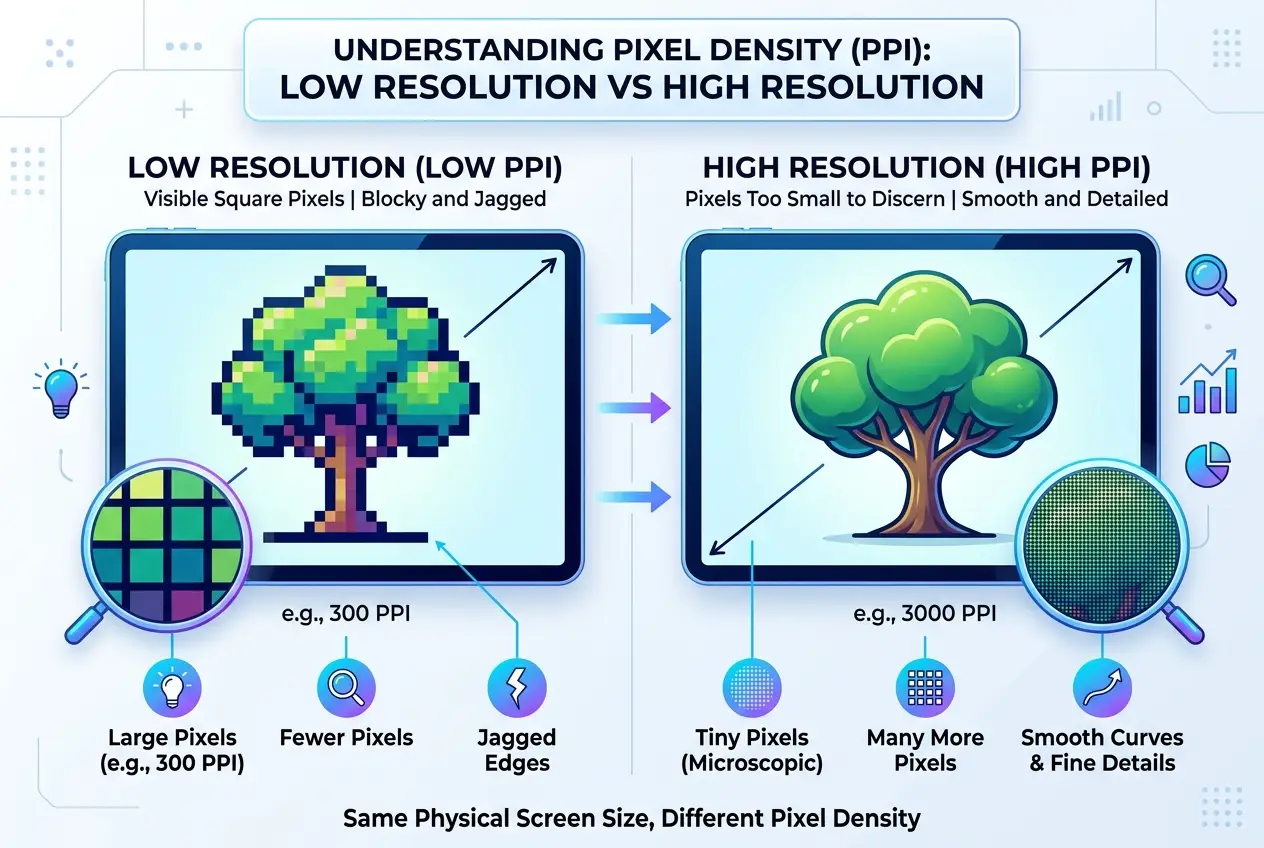
But simply having many pixels isn't enough. Each pixel needs to be able to display a color. This is where the magic truly begins.
### How Pixels Paint with Light: The Subpixel Secret
Every color we see on a digital screen is generated by combining three primary colors of light: **Red, Green, and Blue (RGB)**. You might think each pixel can change its color, but the truth is more intricate. Each individual pixel is actually composed of even smaller units called **subpixels**, one for each primary color.
When you see a pixel displaying, say, yellow, it's not a single yellow subpixel. Instead, the red and green subpixels within that pixel are illuminated to specific intensities, while the blue subpixel remains off or very dim. Our eyes then blend these closely spaced red and green lights, perceiving them as yellow. By varying the intensity of these three subpixels, a single pixel can produce millions, or even billions, of different colors. This is known as the **additive color model**, distinct from the subtractive model used in printing. For a deeper dive into how colors are generated, you can explore the principles of [color theory on Wikipedia](https://en.wikipedia.org/wiki/Color_theory).
### The Two Dominant Technologies: LCD vs. OLED
Currently, two main technologies power the vast majority of our digital screens: **Liquid Crystal Displays (LCDs)** and **Organic Light-Emitting Diodes (OLEDs)**. Understanding their differences helps explain why some screens deliver superior visual fidelity.
#### LCD: The Backlight Brigade
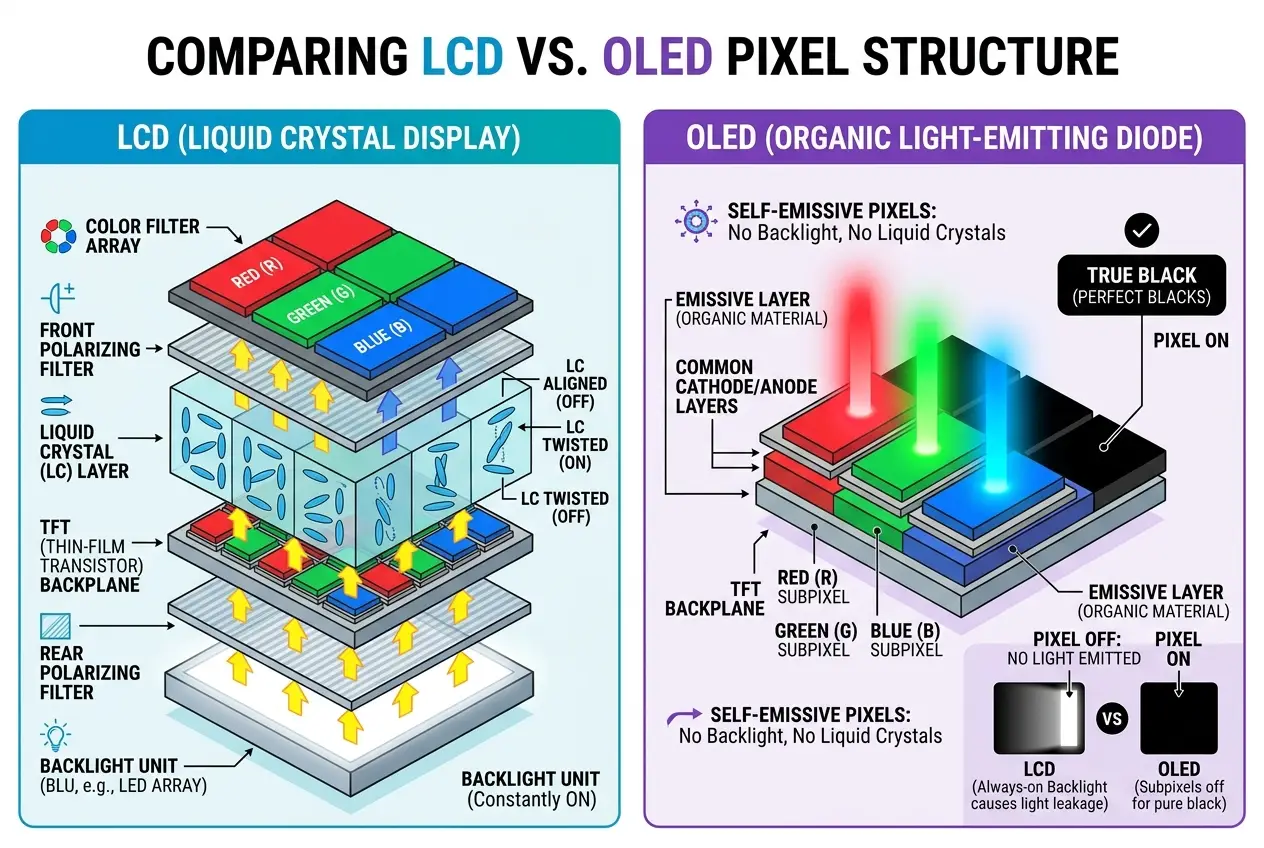
LCD screens work by using a **backlight** (typically LEDs) to shine light through a layer of liquid crystals and color filters. The liquid crystals don't emit light themselves; instead, they act like tiny shutters. When an electrical current is applied, these crystals twist, either allowing light to pass through them or blocking it. This modulated light then travels through the red, green, or blue subpixel filters, creating the desired color and brightness for each pixel.
A key challenge with LCDs is achieving true black. Since there's always a backlight trying to push light through, even when liquid crystals try to block it, a tiny amount of light can "leak" through. This results in blacks that appear more like dark gray. This is often why budget TVs or monitors might show less contrast; their backlight control isn't as precise, affecting the depth of dark scenes.
#### OLED: Pixels That Light Themselves
OLED technology takes a fundamentally different approach. In an OLED display, each individual subpixel is an **organic light-emitting diode** that generates its own light. When an electrical current passes through the organic material, it glows. This means that if a pixel needs to be black, its corresponding OLED subpixels are simply turned off, emitting no light whatsoever. This capability allows OLED screens to achieve **perfect blacks** and an **infinite contrast ratio**, making colors pop with incredible vibrancy and detail, especially in dark scenes.
This self-emissive nature is why high-end smartphones and premium televisions often feature OLED displays. The difference in picture quality, especially in dark environments, is often stunning, creating a depth and realism that LCDs struggle to match. You can learn more about the intricate workings of [OLED technology on Wikipedia](https://en.wikipedia.org/wiki/OLED).
### Beyond Resolution: Refresh Rate and HDR
While resolution and panel technology are crucial, other factors contribute to that "real" feeling:
* **Refresh Rate:** This refers to how many times per second a screen updates its image, measured in Hertz (Hz). A standard screen refreshes at 60Hz, meaning it updates 60 times per second. Higher refresh rates (e.g., 120Hz, 144Hz, 240Hz) reduce motion blur, making fast-moving content like video games or sports look incredibly smooth and fluid. This is why competitive gamers often prioritize high refresh rate monitors; the responsiveness and clarity of motion can make a real difference. If you're curious about how higher refresh rates improve visual fluidity, check out our blog on
audio clarity in wireless earbuds, where similar principles of signal processing enhance real-time experiences.
* **High Dynamic Range (HDR):** HDR technology expands the range of both contrast and color that a display can produce. Instead of just displaying a wider array of colors, HDR also allows for much brighter highlights and deeper, more detailed shadows simultaneously. This results in images that are closer to what the human eye perceives in the real world, adding another layer of depth and realism to your viewing experience. When you see a sunset on an HDR screen, the brightness of the sun and the subtle shades in the clouds are far more impactful than on a standard display. Understanding this can help you appreciate advancements like those discussed in our post on
how gaming GPUs forge reality, which similarly pushes visual boundaries.
### The Science of Perception
Ultimately, the goal of all these display technologies is to trick your brain. Our eyes and brains are remarkably adept at piecing together separate points of light and motion into a coherent, continuous image. The persistence of vision, a phenomenon where the brain retains an image for a fraction of a second after it disappears, plays a crucial role. This is eloquently captured by the famous quote from physicist **Richard Feynman**, who, while speaking about the nature of light, often emphasized the beauty in understanding the underlying mechanisms: "The first principle is that you must not fool yourself—and you are the easiest person to fool." This applies perfectly to how our displays fool us into seeing a seamless reality.
The constant push for higher resolution, better contrast, faster refresh rates, and more accurate color representation is driven by our inherent desire for realism. As technology advances, we move closer to screens that don't just display an image, but truly immerse us in a digital experience that feels almost indistinguishable from reality. From our phones to massive cinema screens, the pixel's secret life is transforming how we interact with and perceive information. It’s a testament to human ingenuity and the relentless pursuit of visual perfection, making our digital worlds more vibrant and compelling with each passing innovation. This continuous innovation is mirrored in other fields, like the quest to decode
gravitational waves' secret language, where advanced technology unravels hidden patterns.
 Join Us



 Alex Rivers






























Leave a Reply
Comments (0)