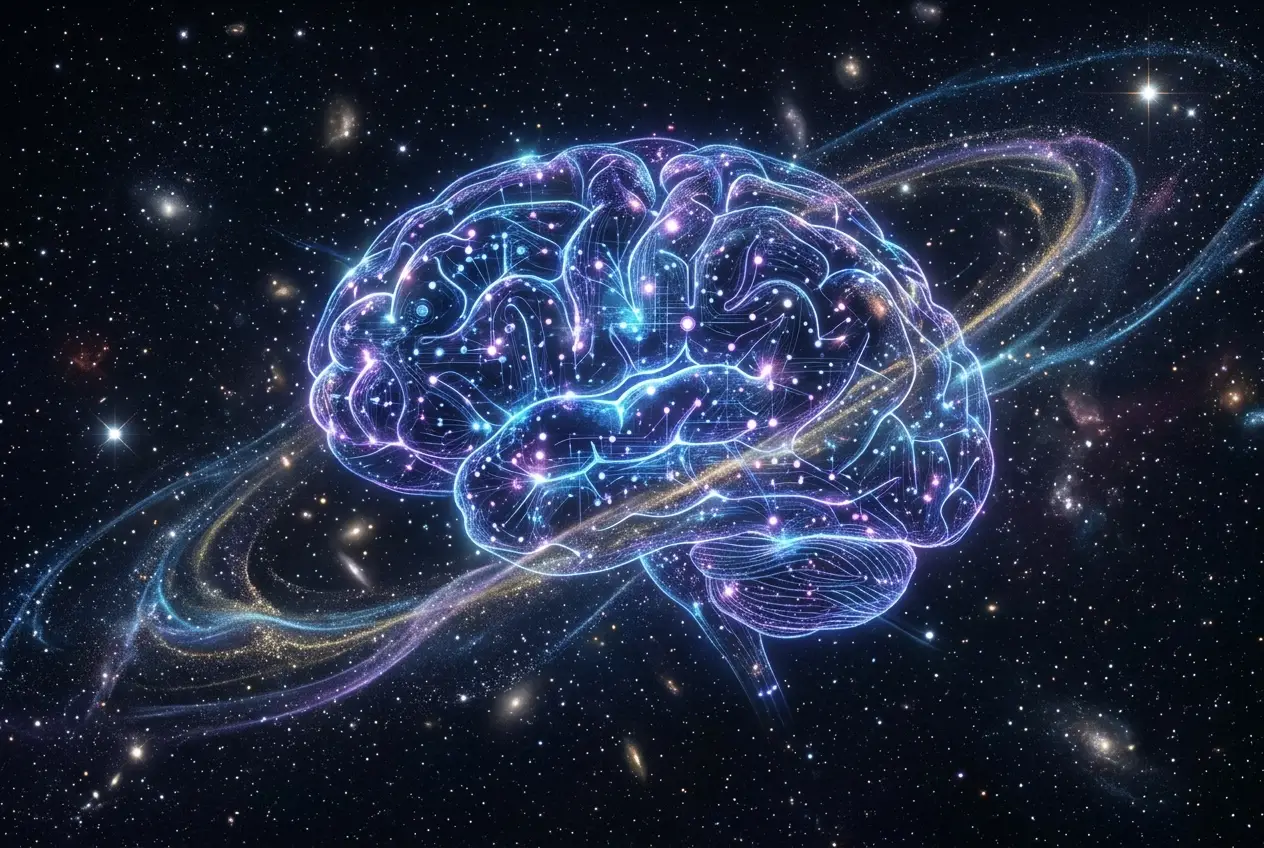
I often find myself contemplating the vastness of the universe, not just in terms of distance, but in what remains unseen, unheard, and unfelt by our conventional senses and instruments. We've built incredible telescopes and detectors, yet a significant portion of the cosmos, the "ghost particles" and dark matter, continues to elude comprehensive understanding. But what if we could enhance our perception, not with new biological senses, but with an intelligence designed to see what we cannot? This isn't science fiction; it's the very real, rapidly developing frontier where Artificial Intelligence (AI) is becoming the universe's most sophisticated cosmic detective.
Imagine a cosmic ballet happening all around us – particles born from distant supernovae, remnants of the Big Bang, and the mysterious dark matter that holds galaxies together – all passing through Earth, and even through our bodies, largely undetected. These are the **"ghost particles"**, so named for their elusive nature and fleeting interactions. For decades, scientists have built massive, intricate detectors, buried deep underground or encased in ice, to catch just a fleeting glimpse of these cosmic wanderers. Yet, the data generated by these behemoths is overwhelming, noisy, and often too subtle for traditional analysis methods to fully uncover. This is where AI steps in, offering a new pair of eyes, a new kind of brain, capable of sifting through the cosmic static to reveal secrets we might otherwise miss.
## The Elusive Universe: What Are Ghost Particles?
Before diving into AI's role, let's understand who our cosmic suspects are. Primarily, we're talking about **neutrinos** and **dark matter candidates**.
**Neutrinos** are perhaps the most famous of the ghost particles. These subatomic particles are nearly massless, carry no electric charge, and interact very weakly with other matter. Trillions of them pass through you every second, primarily from the Sun, but also from cosmic events like supernovae, and even nuclear reactors on Earth. Detecting them requires colossal instruments, often tanks of water or ice, designed to capture the rare instance a neutrino collides with an atom, producing a faint flash of light or a subtle ripple. For instance, detectors like Super-Kamiokande in Japan or the IceCube Neutrino Observatory at the South Pole are monumental efforts to capture these fleeting interactions. You can learn more about these fascinating particles and their properties on their dedicated Wikipedia page: [Neutrino](https://en.wikipedia.org/wiki/Neutrino).
Then there's **dark matter**, the ultimate ghost. It's estimated to make up about 27% of the universe's mass-energy content, yet we've never directly observed it. Its presence is inferred solely from its gravitational effects on visible matter. Scientists hypothesize it could be made of exotic particles like Weakly Interacting Massive Particles (WIMPs) or axions. The search for dark matter is one of the grandest quests in modern physics, involving experiments deep underground to shield them from cosmic rays and other background noise, hoping to detect the incredibly rare interaction of a dark matter particle with ordinary matter. The challenges of detecting dark matter are immense, making it an ideal candidate for AI assistance. Learn more about the mysterious dark matter here: [Dark matter](https://en.wikipedia.org/wiki/Dark_matter).

## Human Limitations and the Noise Problem
For all our ingenuity, human perception and traditional statistical methods have their limits. Particle detectors are essentially giant microphones listening for a whisper in a hurricane. They pick up not only the rare signals from ghost particles but also a tremendous amount of **background noise**: cosmic rays, natural radioactivity in the detector materials, and even thermal fluctuations.
The sheer volume of data is staggering. Modern experiments like those at the Large Hadron Collider (LHC) or neutrino observatories generate petabytes of data annually. Manually sifting through this for tiny, anomalous signals is impossible. Traditional algorithms are excellent at finding what they are programmed to find, but they can be rigid. They might miss subtle, unexpected patterns that don't fit preconceived models – precisely where new physics often hides. This is the **"noise problem"**: how do you distinguish a truly groundbreaking signal from a random fluctuation, or from known background events? It's a needle-in-a-haystack scenario, but the haystack is the size of a galaxy.
## AI to the Rescue: A New Pair of Eyes for the Cosmos
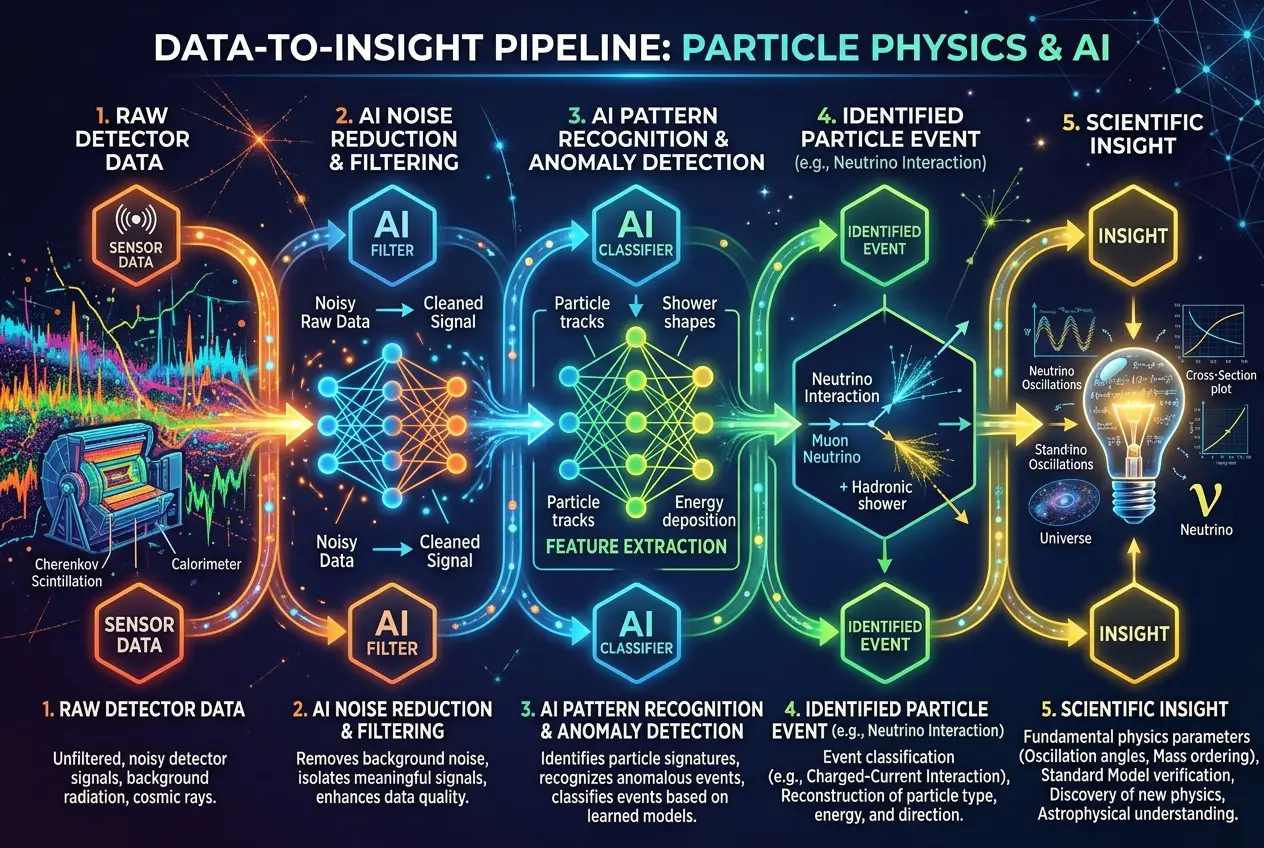
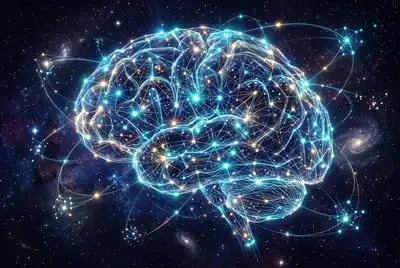
This is where Artificial Intelligence, particularly **machine learning** and **deep learning**, offers a revolutionary approach. AI systems excel at pattern recognition in vast, complex, and noisy datasets – exactly what's needed for ghost particle detection.
AI's specific applications in this field are transforming how we explore the universe:
* **Filtering Noise and Background Events:** Neural networks can be trained on simulated data of both true particle interactions and various forms of background noise. They learn to identify the subtle differences, effectively acting as highly sophisticated filters. This drastically improves the signal-to-noise ratio, making genuine detections stand out.
* **Anomaly Detection:** One of AI's most powerful capabilities is identifying "anomalies" – data points that deviate significantly from learned patterns. In particle physics, these anomalies could be signals of entirely new particles or interactions, something a human might overlook or dismiss as an outlier. AI can flag these unusual events for further investigation, guiding scientists to potential breakthroughs.
* **Accelerating Analysis:** What would take human scientists months or years to analyze, AI can process in hours or days. This rapid analysis allows experiments to explore vast parameter spaces, test more hypotheses, and react faster to incoming data, accelerating the pace of discovery.
* **Reconstruction and Classification:** AI algorithms are superb at reconstructing complex particle trajectories and classifying events based on their signature. For instance, in neutrino detectors, AI can help determine the incoming direction and energy of a neutrino, even from very faint and messy signals.
These advanced algorithms are not just crunching numbers; they are learning from the universe itself, identifying relationships and patterns that are too intricate for human minds or simpler computational models.
## AI in Action: Real-World Cosmic Detectives
The application of AI in astrophysics and particle physics is not a future dream; it's a present reality.
At the **Large Hadron Collider (LHC)**, AI algorithms are indispensable. With billions of particle collisions happening every second, AI helps filter out the mundane interactions from the rare events that might signify new particles like the Higgs boson or signs of supersymmetry. Without machine learning, detecting these fleeting phenomena would be impossible.
The **IceCube Neutrino Observatory** in Antarctica uses AI to distinguish between neutrinos arriving from space and the much more common cosmic ray muons produced in Earth's atmosphere. This allows scientists to pinpoint high-energy neutrino sources in the cosmos, like distant active galactic nuclei or supernovae. The ability of AI to sort through this complex data has been crucial in recent discoveries regarding cosmic neutrinos.
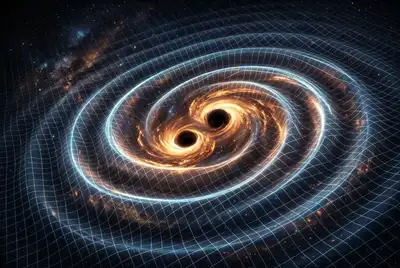
Even in the search for **gravitational waves** by experiments like LIGO, AI plays a critical role in distinguishing the incredibly faint ripples in spacetime from seismic noise and instrumental artifacts. These AI-powered analyses allow scientists to detect events like black hole mergers, which were once thought to be undetectable. I’ve personally been captivated by how deep learning algorithms can extract these subtle patterns from cosmic noise, expanding our cosmic listening capabilities. It really makes you wonder about the limits of what we can hear when our digital tools become so attuned to the universe's whispers. If you want to dive deeper into how digital glitches can sometimes mimic or reveal hidden realities, check out our previous blog: [Digital Anomalies: Can Computers Show Unexplained Behaviors?](/blogs/digital-anomalies-can-computers-show-unexplained-behaviors-1620).
## Beyond Neutrinos: Hunting Dark Matter with AI
While AI is already proving its worth with neutrinos and gravitational waves, its potential in the hunt for dark matter is perhaps even more exciting. Dark matter interactions are predicted to be even rarer and fainter than neutrino interactions. Current dark matter detectors are constantly bombarded with background noise, making it incredibly difficult to isolate a genuine dark matter signal.
AI could revolutionize this search by:
* **Pinpointing Subtle Signatures:** Dark matter interactions might produce unique, incredibly subtle energy deposits or recoil patterns that are buried deep within detector noise. AI, with its ability to learn complex feature spaces, could be trained to recognize these patterns, even if they are barely above the noise floor.
* **Guiding Experiment Design:** By analyzing simulated data, AI could help physicists optimize detector designs, material choices, and shielding techniques to maximize sensitivity to potential dark matter signals.
* **Real-time Anomaly Detection:** Imagine an AI system constantly monitoring a dark matter detector, immediately flagging any statistically improbable event that doesn't fit known background models. This could lead to a rapid identification of a dark matter candidate, allowing scientists to quickly focus their resources. For a fascinating look into other cosmic data mysteries, you might enjoy reading our blog on: [Could Empty Space Hold the Universe's Lost Data?](/blogs/could-empty-space-hold-the-universes-lost-data-7037).
The potential for AI to act as a hyper-sensitive, tireless dark matter hunter is immense, offering hope in one of physics' most challenging quests.
## The Future Is Quantum: What Else Could AI Uncover?
The partnership between human intelligence and AI in cosmic discovery is still in its infancy. As AI models become more sophisticated and computational power increases, we can only imagine the new frontiers they will help us explore.
Could AI help us detect particles that are currently purely theoretical, perhaps even beyond the Standard Model of particle physics? Could it identify exotic phenomena like cosmic strings or micro black holes if they leave incredibly faint, unique signatures? Some physicists even ponder whether AI could process quantum fluctuations in the fabric of spacetime, revealing insights into the very nature of reality. For more on how quantum phenomena might be intertwined with reality, read our blog: [Do Quantum Fluctuations Code Our Reality?](/blogs/do-quantum-fluctuations-code-our-reality-4385).
The future of cosmic discovery increasingly relies on this powerful synergy. Humans formulate the questions and design the experiments, while AI provides the unparalleled capacity to analyze, detect, and potentially even predict what lies hidden in the universe's most subtle whispers. It's a journey not just into the cosmos, but into the potential of intelligence itself – both human and artificial – to unlock the deepest secrets of reality.
## Conclusion
The universe is a treasure trove of mysteries, and many of its most profound secrets are whispered by particles we can barely perceive. From the elusive neutrino to the ghost-like dark matter, these cosmic entities represent vast gaps in our understanding. With AI, we are developing unprecedented capabilities to listen to these whispers, to see the invisible, and to process information on a scale previously unimaginable. This intelligent partnership promises to reshape our understanding of the cosmos, one ghost particle at a time. What other unseen cosmic phenomena do you believe AI could unveil in the coming decades?
Frequently Asked Questions
AI uses machine learning, particularly deep neural networks, trained on vast datasets of both real and simulated particle interactions and various noise sources. It learns to identify subtle patterns and characteristics unique to genuine signals, effectively filtering out background noise with far greater precision than traditional methods.
Scientists are primarily focused on using AI to enhance the detection of neutrinos from cosmic sources (like supernovae and black holes) and the extremely elusive particles that make up dark matter (e.g., WIMPs or axions), which interact very weakly with ordinary matter.
Yes, AI is actively used in several major experiments. For example, it's crucial at the Large Hadron Collider (LHC) for filtering collision data, at the IceCube Neutrino Observatory for classifying neutrino events, and in gravitational wave detectors like LIGO for isolating faint spacetime ripples from noise.
Potentially, yes. By excelling at anomaly detection, AI can flag unexpected patterns in data that don't fit current scientific models. These anomalies could be the first hints of new particles, forces, or interactions, guiding physicists toward discoveries that might lead to new laws of physics beyond our current understanding.
While AI offers immense benefits, ethical considerations include ensuring transparency in AI algorithms to avoid 'black box' issues, mitigating potential biases in training data, and maintaining human oversight to interpret results and prevent misinterpretation. The goal is a collaborative partnership, not a replacement of human ingenuity.
Verified Expert
Alex Rivers
A professional researcher since age twelve, I delve into mysteries and ignite curiosity by presenting an array of compelling possibilities. I will heighten your curiosity, but by the end, you will possess profound knowledge.
Leave a Reply
Comments (0)
No approved comments yet. Be the first to share your thoughts!
 Join Us
 Unknown Author














Leave a Reply
Comments (0)