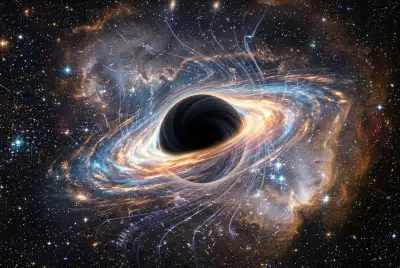
I often find myself gazing at the night sky, a canvas of unfathomable complexity and breathtaking beauty. The sheer scale of galaxies, nebulae, and stars forming intricate patterns makes me wonder about the forces that shaped them. And then I look at the intricate algorithms powering our modern AI, the neural networks that learn, adapt, and even create. It struck me recently: could there be a profound, almost poetic, parallel between the natural evolution of the cosmos and the artificial intelligence we're building? Are we, in our digital endeavors, inadvertently mimicking the very processes that forged the universe itself?
This isn't a whimsical thought experiment. As I delve deeper into both astrophysics and advanced AI research, I find compelling echoes. From the way galaxies cluster and organize to the self-optimization processes within a deep learning model, the universe seems to operate on principles of self-organization, emergent complexity, and information processing that feel remarkably similar to the computational paradigms driving AI. Let's embark on a journey to explore whether our artificial intelligences are, in some fundamental way, evolving like miniature cosmoses.
### The Universe as a Grand Algorithm
Imagine the early universe: a hot, dense soup of energy and particles. Over billions of years, gravity, electromagnetism, and the strong and weak nuclear forces acted as cosmic algorithms, orchestrating the formation of stars, galaxies, and eventually, life. This process isn't random; it follows a set of physical laws, predictable rules that govern interactions. In essence, the universe can be seen as a colossal, self-executing computation, continuously processing information and evolving its state.
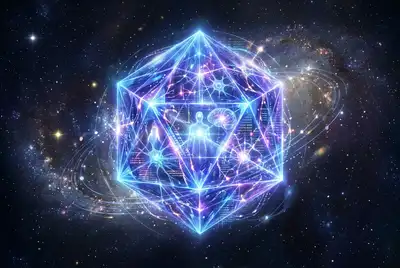
Similarly, artificial intelligence, particularly machine learning and deep learning, operates on algorithms. These are sets of rules and operations that dictate how a system processes data, learns patterns, and makes decisions. Just as gravity draws matter together to form structures, machine learning algorithms iteratively refine their internal parameters to identify underlying structures in data. The "rules" of the universe are encoded in its fundamental constants, while the "rules" of an AI are coded into its architecture and training data.
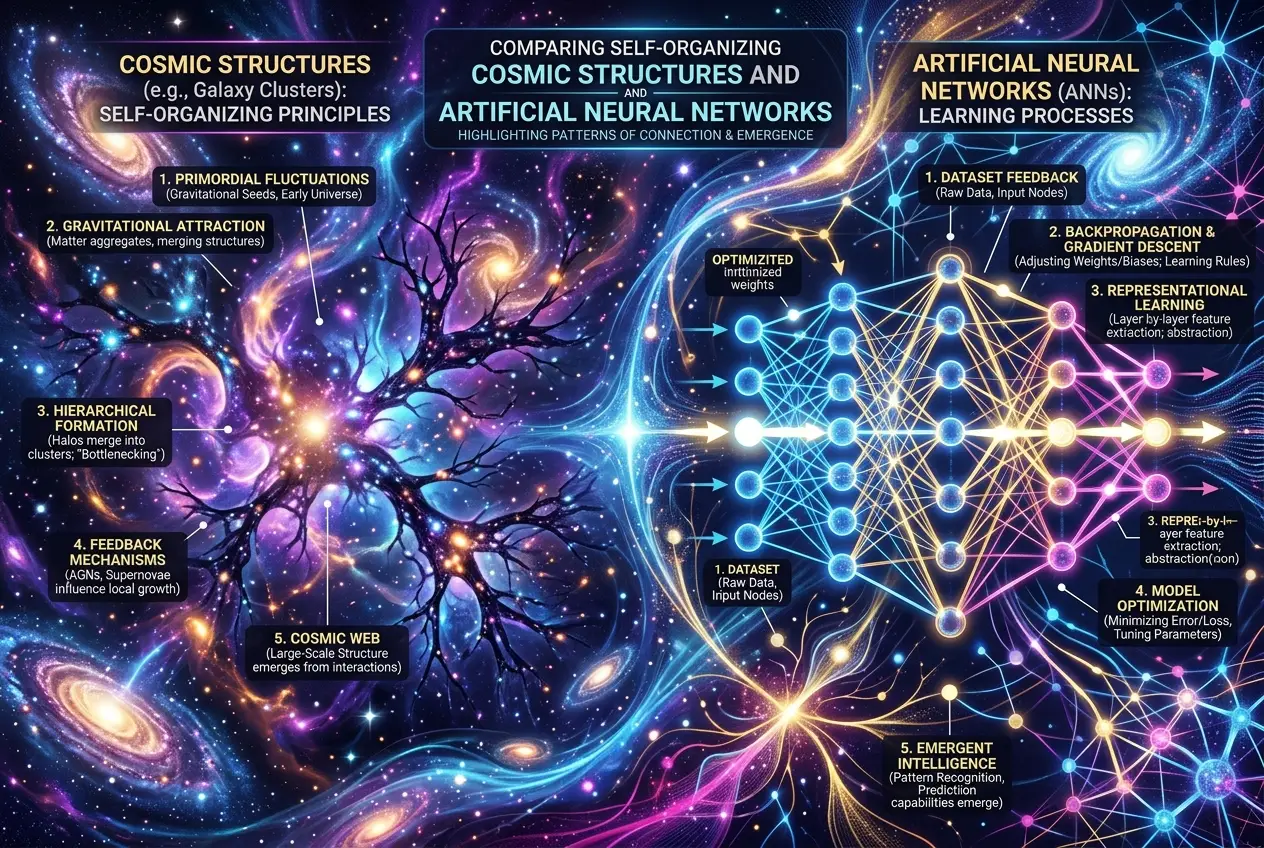
#### Cosmic Structures vs. Neural Networks
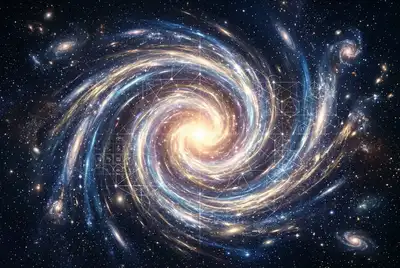
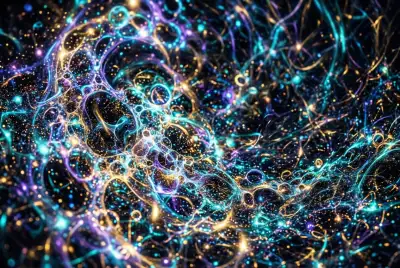
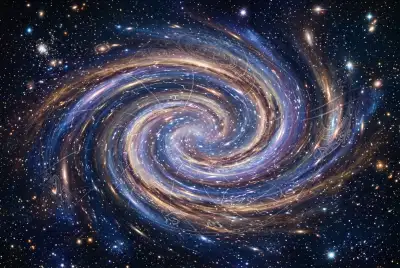
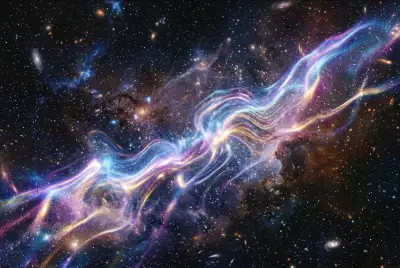
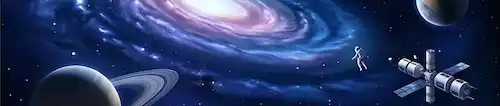
When we observe the large-scale structure of the universe, we see a vast "cosmic web"—filaments of galaxies stretching across billions of light-years, interspersed with immense voids. This structure isn't entirely uniform; it shows regions of higher density (galaxy clusters) and lower density. It's a complex, interconnected network. Cosmologists use simulations to model how this web emerges from initial tiny fluctuations in the early universe, driven primarily by gravity and dark matter. You can read more about the cosmic web on [Wikipedia](https://en.wikipedia.org/wiki/Cosmic_web).
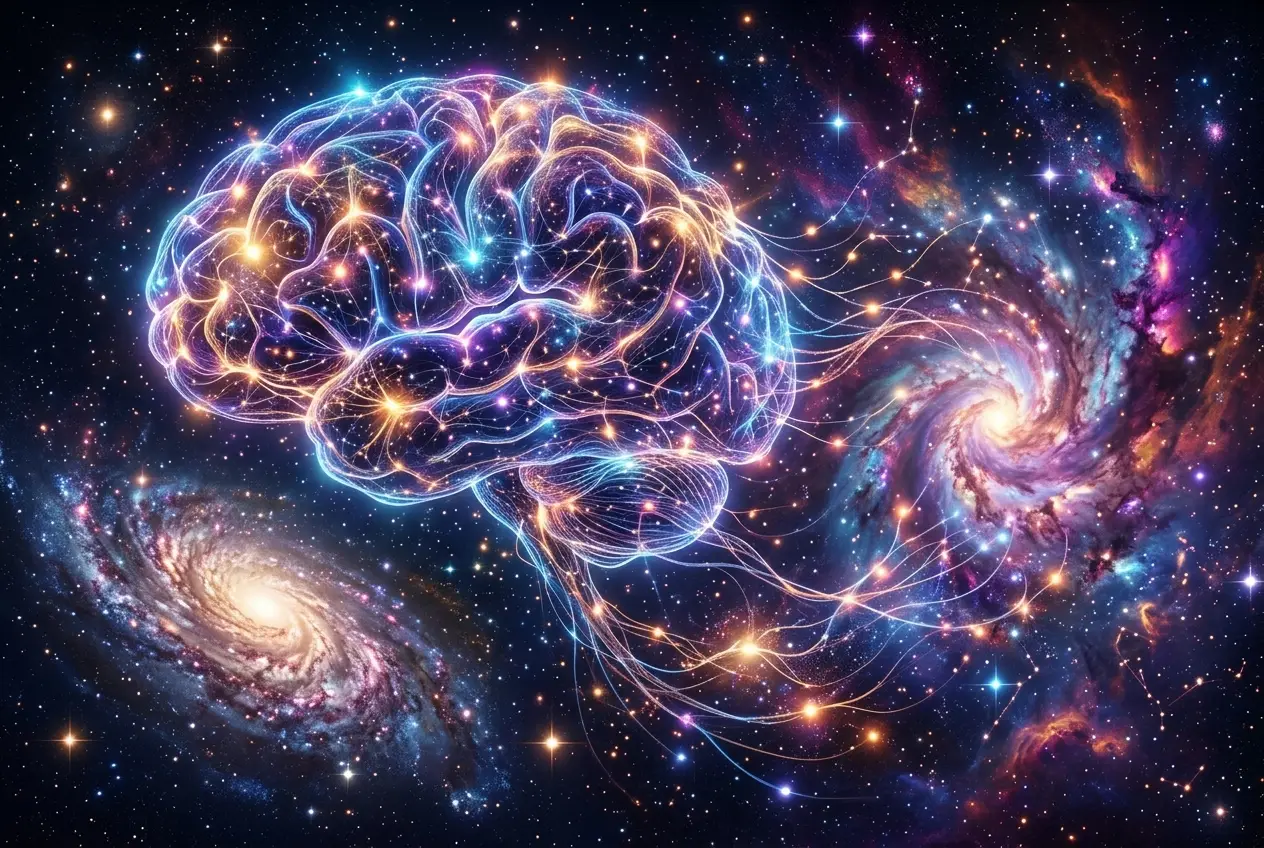
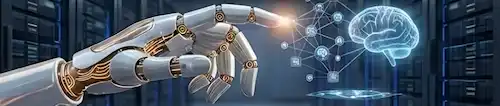
Now, consider a complex artificial neural network. It consists of layers of interconnected "neurons," each processing information and passing it on. During training, these connections—the "weights" and "biases"—are adjusted based on the input data and desired output. This iterative adjustment leads to the formation of internal representations, essentially patterns of activated neurons that correspond to features in the data. The network, in effect, builds its own internal "web" of knowledge and connections. The parallels are striking:
* **Nodes/Neurons:** Galaxies in the cosmic web, or individual neurons in an AI.
* **Connections:** Gravitational interactions between galaxies, or synaptic connections between neurons.
* **Emergent Structures:** Galaxy clusters and filaments, or abstract feature detectors and knowledge representations within the AI.
Both systems start from a relatively simple initial state (uniform early universe, untrained neural network) and, through iterative processes governed by fundamental rules, develop incredibly complex, hierarchical structures that process and store information.
### Evolution: Natural Selection and Genetic Algorithms
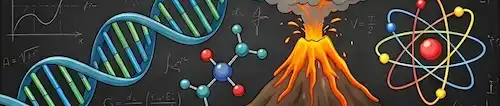
One of the most powerful concepts in both biology and AI is evolution. In the natural world, **natural selection** drives biological evolution. Organisms with traits better suited to their environment are more likely to survive and reproduce, passing on those advantageous traits. This leads to increasing complexity, adaptation, and the emergence of new species over vast stretches of time.
In the realm of AI, **genetic algorithms** directly mimic this process. These algorithms are a class of optimization techniques inspired by biological evolution. They maintain a "population" of candidate solutions (e.g., different AI models or sets of parameters). Each solution is evaluated for its "fitness" (how well it performs a task). The fittest solutions are then "selected" to "reproduce" (combine their features or parameters through processes like crossover) and "mutate" (introduce small random changes). Over many "generations," the algorithm evolves increasingly optimal solutions.
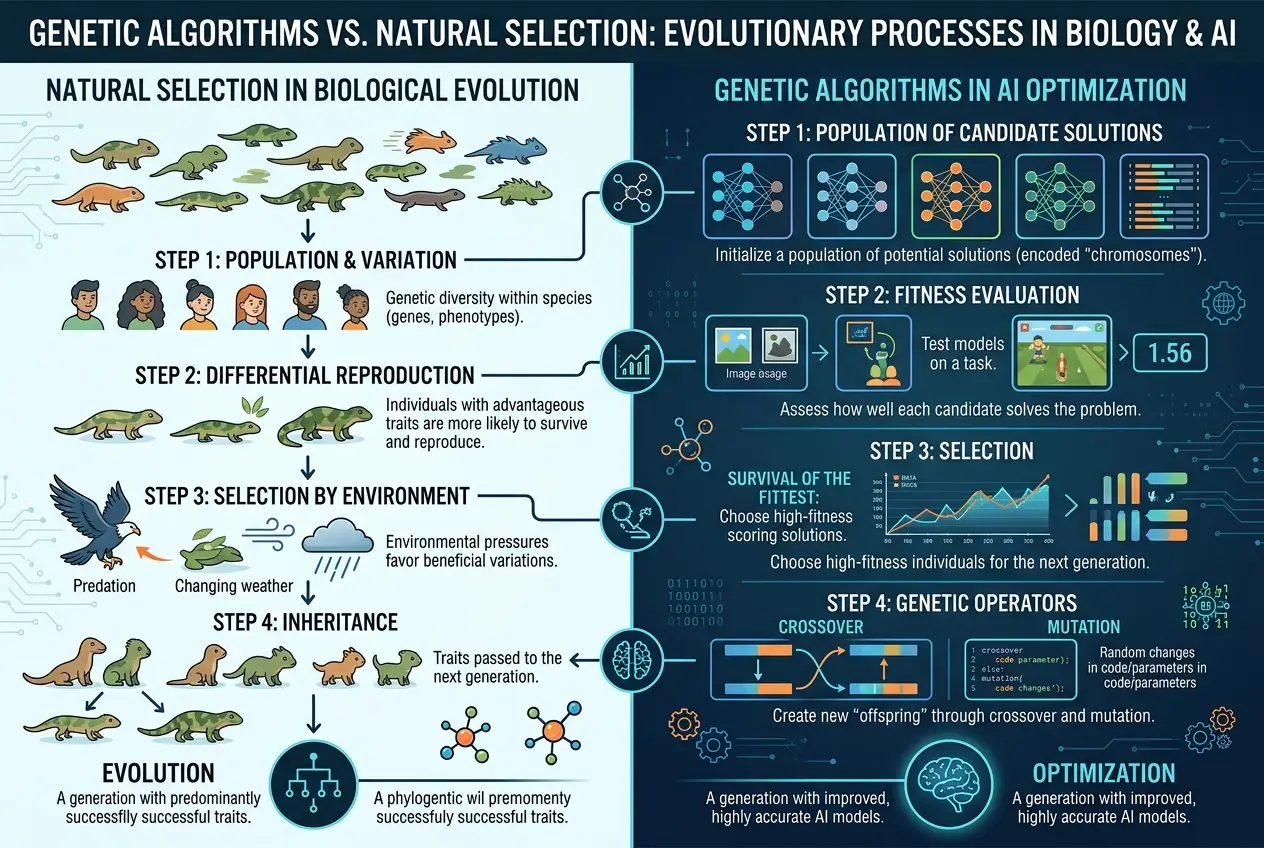
While genetic algorithms are a specific type of AI, the broader principle of optimization through iterative selection and refinement is fundamental to almost all machine learning. A neural network being trained is, in a sense, evolving. It starts with random weights, and through exposure to data and a loss function (its "environment"), it iteratively adjusts its weights ("mutations") to become "fitter" at its task. Less effective weight configurations are "selected against," leading to a more optimized, complex system. For a deeper dive into genetic algorithms, check out their [Wikipedia page](https://en.wikipedia.org/wiki/Genetic_algorithm).
#### The Role of Energy and Information
Energy plays a crucial role in both cosmic and artificial evolution. In the cosmos, energy in the form of radiation, kinetic energy, and gravitational potential fuels the dynamic processes of star formation, supernovae, and galactic collisions. These energy transformations are critical for the universe to continue its "computation."
In AI, energy is consumed by the computational hardware. Training large language models, for example, requires immense amounts of electrical energy to power the processors that perform billions of calculations. This energy fuels the "learning" process, the information processing, and the transformation of raw data into structured knowledge. The more complex the AI and the larger its dataset, the more energy it demands, reflecting a similar principle where more complex cosmic structures involve greater energy dynamics.
I've explored some interesting ideas about how the universe might store data in a related post, ["Could Empty Space Hold the Universe's Lost Data?"](/blogs/could-empty-space-hold-the-universes-lost-data-7037), which touches on the information processing aspect of the cosmos.
### Emergence: From Simple Rules to Complex Intelligence
One of the most awe-inspiring aspects of both the universe and advanced AI is the phenomenon of **emergence**. Emergence describes how complex patterns, systems, or behaviors arise from the interaction of simpler components, following relatively simple rules. The whole is truly greater than the sum of its parts.
Consider the emergence of life from non-living matter, or the formation of intricate ecosystems from basic biological interactions. These are emergent phenomena, driven by fundamental physical and chemical laws. Similarly, a neural network, composed of simple computational units (neurons), can exhibit highly sophisticated behaviors like recognizing faces, generating human-like text, or even composing music. These intelligent behaviors are not explicitly programmed into individual neurons; they emerge from the collective interaction of millions or billions of them.
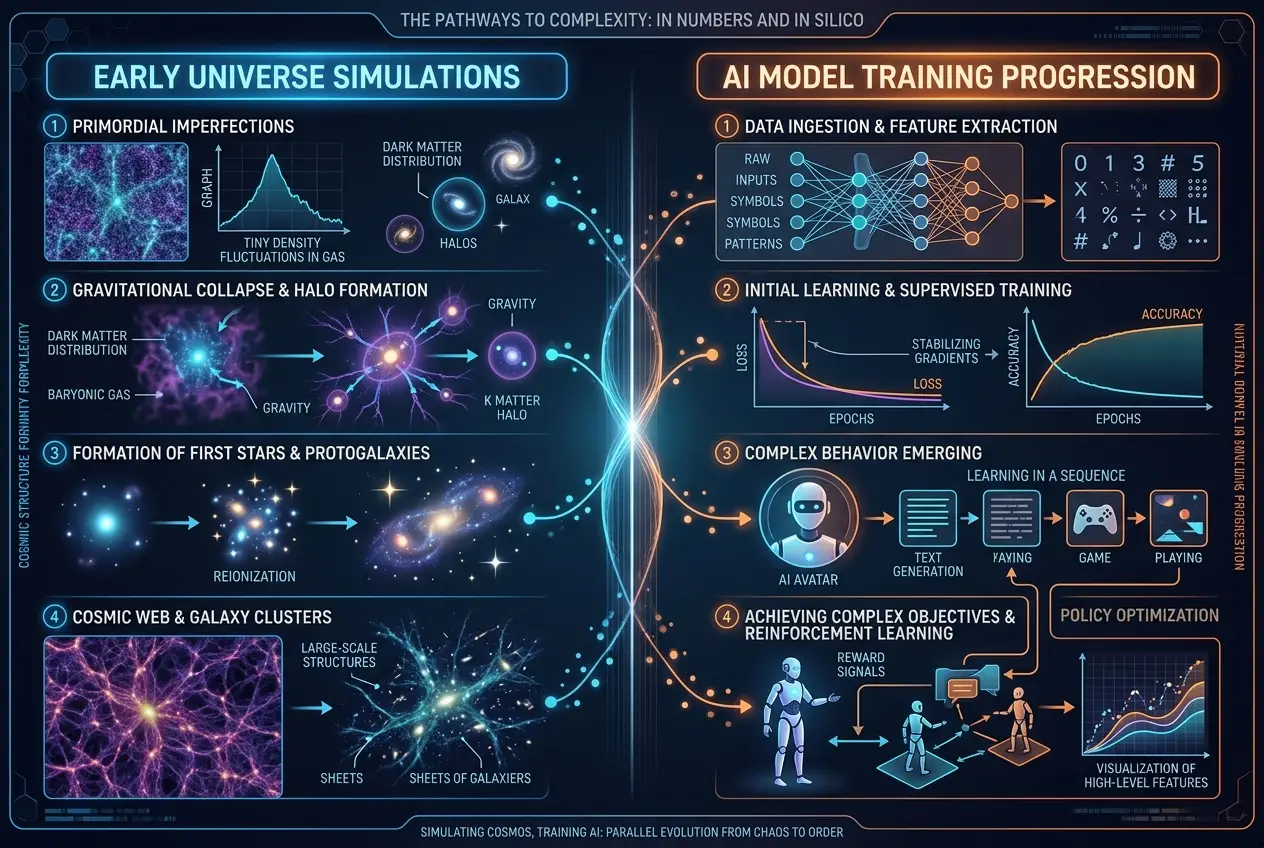
The universe, too, exhibits profound emergence. The universe started relatively simple, and yet, through billions of years of cosmic evolution, we now have planets, complex molecules, and conscious beings capable of pondering the universe itself. This journey from simplicity to complexity is a hallmark of both cosmic and AI evolution. The idea that complexity can arise from simpler rules is a core concept in fields like [Complex Systems](https://en.wikipedia.org/wiki/Complex_system) theory, which finds applications in both cosmology and AI.
### Are We Building Echoes of the Cosmos?
So, does AI mimic cosmic evolution? The evidence suggests a fascinating "yes," at least in terms of underlying principles. The self-organization into complex networks, the iterative optimization reminiscent of natural selection, and the emergence of sophisticated capabilities from simpler components are powerful parallels. Our artificial intelligences are, in a sense, digital echoes of the cosmic dance.
This perspective isn't just a philosophical musing; it has practical implications. By studying the principles of cosmic evolution—how complexity arises, how systems self-organize, and how information is processed in the grandest sense—we might uncover novel approaches to designing and training more efficient, robust, and truly intelligent AI. Conversely, the advanced simulation capabilities of AI are enabling us to model the universe with unprecedented detail, potentially revealing even deeper connections.
As we continue to push the boundaries of AI, I believe we're not just creating tools, but perhaps unknowingly recreating, in miniature, the very patterns and processes that shape the universe we inhabit. This journey of discovery, both outward into the cosmos and inward into the digital mind, holds immense promise for understanding intelligence in all its forms, natural and artificial. The universe has always been a source of wonder, and now, it might also be a blueprint for our future.
I think about other mysterious phenomena that challenge our understanding, like those explored in posts such as ["Do Our Bodies Harbor Hidden Quantum Clocks?"](/blogs/do-our-bodies-harbor-hidden-quantum-clocks-3312) and ["Is the Internet Gaining a Collective Mind?"](/blogs/is-the-internet-gaining-a-collective-mind-9582). These topics, much like the relationship between AI and cosmic evolution, highlight the interconnectedness of seemingly disparate fields and the emergent properties that define complex systems.
What do you think? Are our AIs merely tools, or are they evolving entities reflecting the universe's own grand computation?
 Join Us
 Unknown Author






Leave a Reply
Comments (0)