


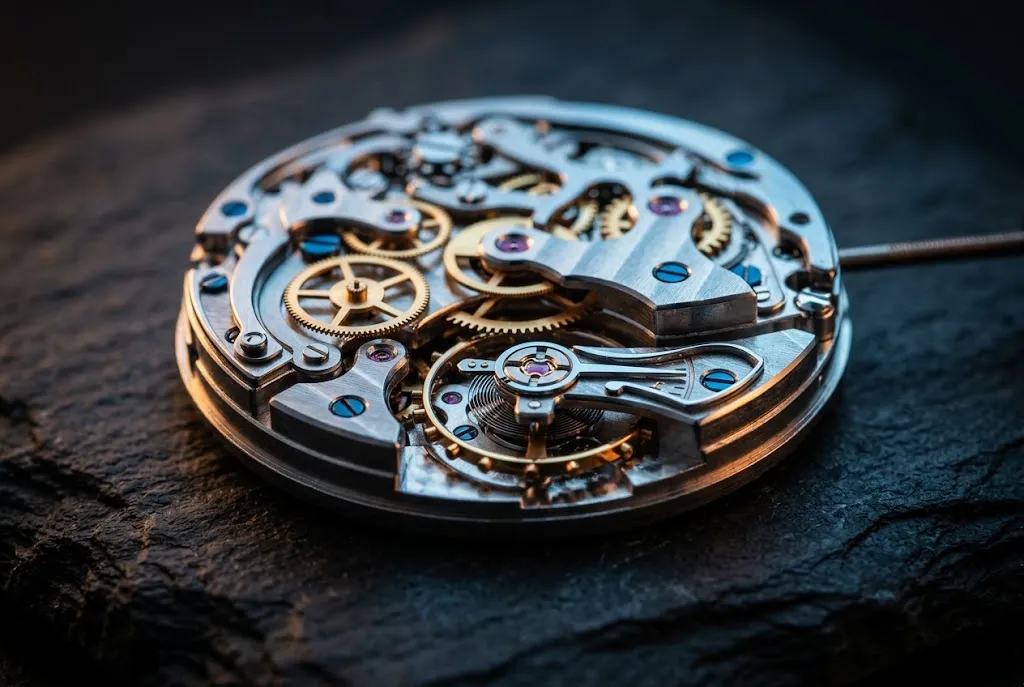
I remember pressing my ear against my grandfather's gold-cased pocket watch when I was eight years old. It did not hum like an electric refrigerator. It chattered. A rapid, tiny metallic flutter ringing out five distinct strikes every single second.
There was no circuit board inside that casing. No battery. No solar strip catching ambient room light. When you strap a mechanical watch to your wrist, you are wearing an autonomous kinetic computer that tracks the passage of the universe entirely through coiled metal, jewel pivots, and interlocking brass teeth. Stripped of lithium cells and silicon microchips, how does a mechanical watch work with enough precision to keep you on schedule throughout your day?
Not by magic. Pure mechanics.
The Architecture of a Mechanical Watch
Every mechanical timepiece, whether an inexpensive hand-wound field watch or a six-figure Swiss tourbillon, solves a single fundamental physics problem. It must store raw kinetic potential energy, release that energy in microscopic, identical increments, and translate those increments into rotating geometric pointers across a dial.
Looking at the intricate mechanism of a watch through an optical loupe, you quickly realize it is divided into five distinct sub-assemblies working in tight choreography:
- The mainspring barrel (potential energy storage)
- The gear train (energy transmission and velocity step-up)
- The escapement (the energy brake and meter)
- The balance assembly (the resonant timekeeping oscillator)
- The motion works (display gearing that drives the hands)
If any one of these subsystems falters by even a fraction of a millimeter, the entire machine either races out of control or grinds to a dead halt. The balance between friction, momentum, and elasticity is brutally unforgiving.
Storing Mechanical Potential: The Mainspring Barrel
Where does the motion begin? Inside a flat, shallow toothed drum called the mainspring barrel.
Tightly coiled inside this drum is an S-shaped ribbon of specialized metal alloy, typically an iron-nickel-cobalt formulation like Nivaflex. When you turn the winding crown, you manually wind this ribbon tighter around a central arbor. Elastic potential energy.
The spring desperately wants to unwind and return to its resting equilibrium state, exerting a continuous rotational force (torque) against the toothed outer rim of the barrel.
In manual timepieces, your fingers supply that energy by turning the crown every morning. In automatic mechanical watches, an off-center weighted metal rotor mounted on tiny ball bearings swings freely with the natural sway of your arm. Every time you lift a coffee cup or reach for your steering wheel, gravity pulls the heavy rotor downward, turning a reduction gear that automatically winds the mainspring for you.
The Gear Train: Stepping Up Speed, Not Torque
Here is the part that surprises almost everyone: watch gears do the exact opposite of what car transmissions do.
In an automobile, a gearbox steps down the rapid rotation of the engine crank to multiply torque so heavy tires can roll forward. A watch mainspring, however, already has massive torque. If you hooked the mainspring barrel directly to the hands, the coiled spring would violently dump all its stored energy in two seconds flat. The hands would spin like propeller blades, and the watch would stop.
To prevent that catastrophe, the gear train (traditionally called the "going train") steps up the rotational speed while stepping down the torque across four cascading wheels:
- The Mainspring Barrel drives the Center Wheel, which completes exactly one revolution per hour (carrying the minute hand).
- The Center Wheel drives the Third Wheel, acting as an intermediate velocity amplifier.
- The Third Wheel drives the Fourth Wheel, which rotates exactly once every 60 seconds (carrying the second hand).
- The Fourth Wheel finally drives the Escape Wheel pinion.
Centuries ago, ancient Greek engineers used interlocking bronze gear teeth inside the Antikythera Mechanism to calculate lunar cycles and solar eclipses. Modern horologists took that same rotational geometry and miniaturized it to sub-millimeter tolerances.
So, how does a watch work when high torque is desperate to unwind all those gears at once? Something has to stop the geartrain from free-spinning.
The Escapement and Balance Wheel: Slicing Time into Micro-Seconds
This is the true brain of the movement: the Swiss lever escapement (opens in a new tab) paired with an oscillating balance wheel.
If the mainspring is the engine and the gear train is the transmission, the balance assembly is the pendulum. But you cannot fit a grandfather clock pendulum into a watch case that you swing around all day. In 1675, Dutch physicist Christiaan Huygens helped solve this by co-inventing the balance spring (opens in a new tab), often called the hairspring. It is a coiled metallic spring, thinner than a human hair, attached to a weighted flywheel.
When the wheel rotates in one direction, the hairspring tightens, resists the motion, brings the wheel to a dead stop, and flings it back in the opposite direction. Back and forth. Over and over.
Because the balance assembly possesses physical inertia and a fixed spring stiffness, its oscillations exhibit isochronism: every swing takes the exact same amount of time regardless of whether the swing is wide or narrow. It is a resonant harmonic oscillator.
The escapement wheel wants to spin forward, but an anchor-shaped lever tipped with synthetic ruby arms blocks it. Here is the cycle, step by step:
- The balance wheel swings, and a tiny jewel pin on its hub taps the pallet fork.
- The fork rocks aside, unlocking the escape wheel and allowing it to advance by exactly one tooth.
- As the escape tooth slips past, its angled ramp delivers a tiny push (an "impulse") back to the pallet fork, which shoves the balance wheel to keep it swinging against friction.
- The second ruby arm drops into the path of the next tooth, locking the gear train again with a metallic click.
Tick. Tock.
Most modern mechanical watches oscillate at a frequency of 28,800 vibrations per hour (4 Hz). That means the balance wheel swings forward and backward eight times every single second.
This is why a mechanical watch sweeping second hand glides in a smooth flutter rather than jumping in the sharp, staccato clicks of the quartz clock hanging on your kitchen wall. A quartz clock pauses for one whole second before firing its stepper motor; the mechanical gear train is unlocked and advanced eight separate times per second.
Controlling Friction: Why Watches Run on Synthetic Rubies
Metal rubbing against metal at eight cycles per second will chew through brass shafts in a matter of months.
The secret to keeping a watch working with high precision for decades is friction mitigation. Watchmakers do not use steel ball bearings for delicate pivots; they use tiny doughnut-shaped jewel bearings (opens in a new tab) carved from synthetic corundum (ruby and sapphire).
Synthetic ruby has a Mohs hardness of 9, second only to diamond. It can be polished to an almost frictionless mirror surface. Microscopic droplets of specialized synthetic oil sit suspended inside the jewel cups via capillary action, cushioning the steel pivot pins indefinitely.
Why Temperature and Magnetism Threaten Precision
Because a mechanical watch relies on the physical dimensions of metal, everyday physics can disrupt it.
Heat expands the hairspring, making it weaker and causing the watch to lose time. Cold shrinks it, making it stiffer and causing the watch to gain time. Modern alloys like Glucydur and silicon hairsprings largely neutralize this thermal vulnerability.
Magnetism is the more insidious everyday villain. If an electromagnetic field magnetizes the hairspring, the delicate coils stick to each other. When coils stick, the active length of the spring becomes shorter, causing the balance wheel to oscillate violently fast.
This is why your grandfather's vintage watch suddenly gains five or ten minutes a day after accidentally resting on a laptop's magnetic speaker grill.
While modern satellites depend on microwave transitions inside atomic clocks to pinpoint coordinates via GPS, a mechanical watch achieves reliable timekeeping without a single photon of electricity or radio signal.
What Keeps Mechanical Timekeeping Alive?
When people ask how do mechanical watches work in an era dominated by smart screens, the answer isn't about raw utility. It is about enduring physical logic.
Smartwatches become obsolete e-waste in five years when their batteries swell and servers go dark. But a mechanical watch from 1924, freshly cleaned and oiled, will beat with the exact same 4-hertz cadence in 2124. (And honestly, looking at a balance wheel breathing through a 10x loupe for the first time is hypnotic in a way no glass touchscreen can match.)
It is a closed kinetic loop. Pure mechanics, measuring entropy one tiny, defiant oscillation at a time.




Conversation0
No comments yet. Be the first to share a thought — the best questions often become new stories.