


The Magnet Trick That Physics Forbids
I used to assume magnetic levitation was simple. You take two bar magnets, turn the north poles toward each other, feel that squishy invisible cushion, and float one on top of the other. Done, right?
Not quite.
Try balancing two ordinary permanent magnets that way on your kitchen table. The top magnet wobbles for half a heartbeat, flips violently over, and snaps flat against its partner with a loud click. It refuses to float. It will always slip sideways because static magnetic fields cannot create a stable, self-correcting pocket in three dimensions.
A British mathematician named Samuel Earnshaw proved this mathematically all the way back in 1842. Under Earnshaw's theorem (opens in a new tab), no static configuration of permanent magnets can ever hold an object in stable, motionless equilibrium against gravity. One nudge sideways, and the levitation collapses instantly.
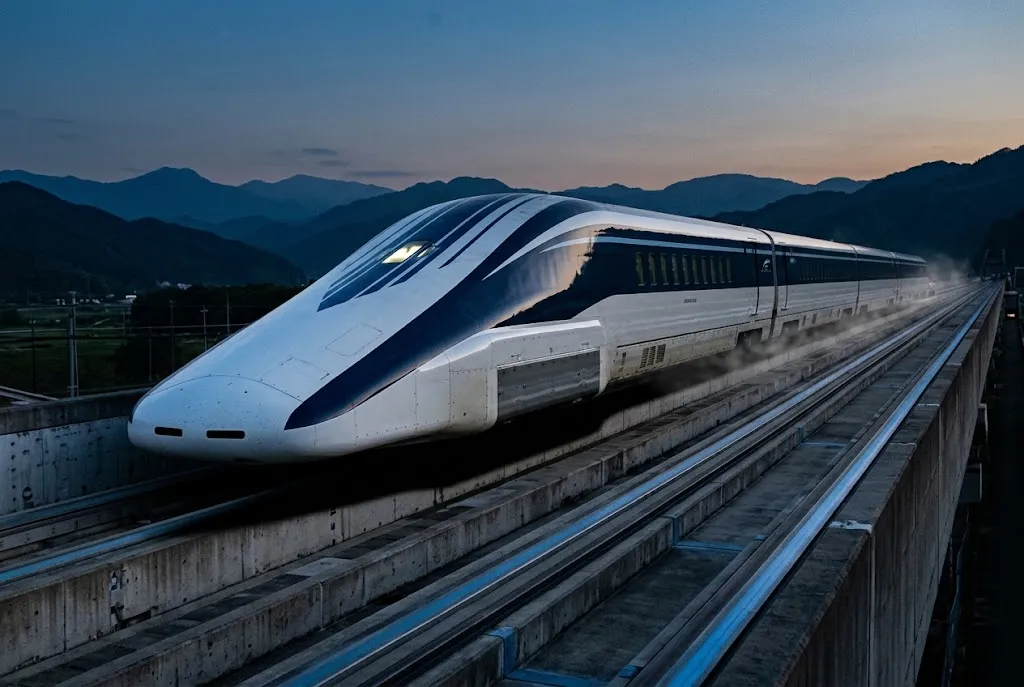
So whenever I watch footage of a 30-ton train gliding down a concrete track at 375 miles per hour with zero wheels touching metal, my brain still stumbles for a second. It looks like a magic trick. But engineers did not break Earnshaw's theorem to make maglev work—they outmaneuvered it using two radically different engineering philosophies.
The German Answer: Hanging Upward with Active Feedback
Take a close look at the Shanghai Maglev, which is based on the German Transrapid system. Most people assume the train sits on top of the guideway and pushes down against it.
It does the exact opposite.
The undercarriage of the train wraps around a steel T-shaped guideway like a pair of mechanical hands cupping a banister from underneath. The lift electromagnets sit on those wraparound arms, pointing up toward the bottom of the steel track. When current flows through them, they do not push away from the guideway. They try to stick to it.
They are actively trying to jump upward and clamp onto the track.
This method is called Electromagnetic Suspension (EMS). The train levitates by magnetically pulling itself up toward the steel rail, maintaining a tiny clearance gap of just 15 millimeters (about the thickness of an index finger). If the magnetic pull is too strong, the train slams into the underside of the track. If the pull is too weak, the train drops onto its emergency skid pads.
To keep this knife-edge balance from failing, inductive sensors measure that 15mm gap roughly 100,000 times every second. If the gap narrows by a single millimeter, the onboard computer instantly dials back electrical current. If the gap widens, current spikes. The train hovers in an endless state of micro-adjustments happening faster than human nerve impulses can travel.
And unlike other levitation designs, an EMS train can hover while completely stationary. You can step onto a Transrapid train while it is parked at the station platform, and the vehicle is already floating mid-air.
The Japanese Answer: Supercooled Coils and 90 MPH Takeoffs
Engineers in Japan looked at Germany's 15mm air gap and decided it was far too tight for earthquake-prone regions. If a seismic tremor bends a guideway even slightly, a 15mm clearance does not leave much margin for error.
Their solution was Electrodynamic Suspension (EDS), the technology powering the Central Japan Railway's record-setting SCMaglev (opens in a new tab) L0 Series. Instead of pulling up from below, Japanese maglev trains push down from above using true magnetic repulsion. But because Earnshaw's theorem forbids this with static magnets, they use dynamic motion and electromagnetic induction.
The train carries onboard superconducting electromagnets made from niobium-titanium alloy, chilled to -452°F (-269°C) using liquid helium. At those near-absolute-zero temperatures, electrical resistance drops to dead zero—an effect known as superconductivity (opens in a new tab). Once an electrical current is loaded into these coils, it circulates indefinitely without losing power, producing enormous magnetic fields identical to the tech found inside MRI scanners.
The guideway walls are lined with unpowered figure-eight-shaped copper coils. As the train races past, its powerful onboard magnets sweep across these passive copper loops, inducing an electric current inside them via Faraday's law of induction. (This relies on the same electromagnetic induction principles that drive induction cooktops, except here the induced currents generate mechanical lift rather than heat inside a skillet).
Here is the brilliant part: the induced current makes the bottom half of the figure-eight coil act like an identical magnetic pole (repelling the train upward), while the top half acts like an opposite pole (attracting the train upward). Together, they hoist the train a massive 4 inches (10 centimeters) into the air.
There is just one catch. The coils in the guideway only produce a magnetic field when the train is already moving fast enough to induce current.
This is why Japan's bullet train needs airplane-style rubber landing gear before it hits 93 mph—it literally cannot levitate at a crawl.
At low speeds, the train rolls down the track on rubber tires like a commercial jet taxiing toward a runway. Once the speedometer crosses roughly 93 mph (150 km/h), the induced magnetic fields become strong enough to lift the entire train off the ground. The landing wheels retract into the belly, and the train flies on an invisible magnetic cushion.
| Feature | Electromagnetic Suspension (EMS) | Electrodynamic Suspension (EDS) |
|---|---|---|
| Primary Mechanism | Magnetic attraction (pulling up toward rail) | Magnetic repulsion (pushing away from coils) |
| Levitation Gap | ~15 mm (~0.6 inches) | ~100 mm (~4.0 inches) |
| Levitates at Standstill? | Yes, constantly adjusted by computers | No, requires forward speed (>90 mph) |
| Magnet Type | Conventional electromagnets | Superconducting electromagnets (cryogenic) |
| Primary Example | Shanghai Maglev (Transrapid) | L0 Series SCMaglev (Japan) |
How to Move a 30-Ton Train Without an Onboard Engine
Floating is only half the puzzle. Once a train is suspended in mid-air, how do you actually push it forward?
There are no drive axles. There are no spinning wheels gripping a rail. In fact, the train does not even carry an internal propulsion engine.
The secret is a linear synchronous motor (opens in a new tab). To picture how this works, take a regular electric motor from a power drill and imagine cutting the circular outer casing open, then unrolling it flat into a long straight line. That flattened motor is the guideway track.
The walls of the track are packed with three-phase propulsion coils connected to electrical substations. When the substations send alternating electrical currents through these coils, they generate a continuous wave of alternating North and South magnetic poles traveling down the length of the track.
The train's onboard magnets lock directly into this moving wave. A North pole on the track sits just ahead of a South pole on the train, pulling it forward. Simultaneously, another North pole sits just behind the train's North pole, shoving it from behind. British engineer Eric Laithwaite, who pioneered modern linear motors, once put it simply: "Nature hates a field out of balance, but if you move the field fast enough, the metal has no choice but to follow."
The train rides that electromagnetic wave like a surfer catching an ocean swell. To accelerate, the substations increase the frequency of the alternating current, making the magnetic wave travel faster. To brake, the engineers reverse the polarity of the wave, pulling against the train's momentum to harvest kinetic energy back into the power grid.
The Invisible Walls: Why Maglevs Cannot Derail
People often ask me what keeps a maglev from drifting sideways and smashing into the guideway wall during a gust of wind. You cannot steer a hovering train with a steering wheel.
The stability comes from an ingenious passive feedback geometry known as null-flux centering.
The figure-eight coils on opposite sides of the track are wired together in cross-connected pairs underneath the floor. When the train is sitting dead center between the walls, the magnetic pull from both sides is balanced, and net electrical current between the paired coils is zero.
Now imagine a severe crosswind shoves the train 5 millimeters to the left.
As the train gets closer to the left wall, the magnetic induction on that side spikes, while induction on the right wall drops. That imbalance immediately forces electrical current to rush through the cross-connecting wires. The left coils develop a powerful repulsive magnetic field pushing the train away, while the right coils create an attractive field pulling it back toward the middle.
The harder the wind pushes the train off-center, the harder the physics pushes back. No computer processing required. No mechanical linkages. The physical geometry of the circuit makes centering automatic and instantaneous.
In fact, traditional derailment is mechanically impossible on a maglev guideway. On an EMS train, the undercarriage physically wraps around the steel track like an interlocking puzzle piece. On an EDS train, the vehicle runs inside a deep concrete trench; jumping the track would require overcoming hundreds of tons of magnetic centering forces.
If It Is So Fast, Why Isn't Every Train Floating?
If maglevs eliminate mechanical friction, achieve speeds over 370 mph, and experience almost zero mechanical wear, why are we not riding them between every major city?
It comes down to track interoperability and brutal economics.
Traditional high-speed rail systems, like Japan's Shinkansen or France's TGV, use the global standard 1,435-millimeter steel gauge. A brand-new high-speed bullet train can roll right onto century-old conventional tracks when pulling into a crowded city center. That flexibility saves billions in downtown real estate.
A maglev cannot share a millimeter of conventional track. Every single mile requires custom-engineered, millimeter-precise concrete guideways embedded with thousands of copper coils, continuous electrical cabling, and dedicated cryogenic cooling stations. Building Japan's Chuo Shinkansen maglev line between Tokyo and Nagoya has cost over $60 billion, largely because nearly 90% of the route must run through bored mountain tunnels to keep the track arrow-straight.
Then there is air resistance. Maglev wipes out mechanical friction between wheels and rails, but at 300 miles per hour, wheel friction only represents about 10% of total energy loss anyway. The remaining 90% is aerodynamic drag—slamming headfirst into a wall of air molecules.
The Real Triumph of Riding on Air
Maglev is one of those rare technologies that feels like it belongs in the 22nd century. It replaces grease, bearings, and steel flanges with pure electromagnetic fields.
When you strip away the science fiction aesthetic, maglev is not about defying gravity with brute force. It is about using dynamic feedback to dance around a 180-year-old physics theorem that says you shouldn't be floating in the first place.
The next time you see a maglev gliding silently down a guideway without a whisper of engine roar, look closely at that empty gap of air beneath the chassis. That empty space is doing all the heavy lifting.





Conversation0
No comments yet. Be the first to share a thought — the best questions often become new stories.